

Funke Akindele’s Behind The Scenes Hits ₦1.1bn In 19 days

Funke Akindele’s Behind The Scenes hits ₦1.1bn in 19 days, becoming the fastest film in West African history to cross ₦1bn.
Beyoncé Officially Becomes a Billionaire After $400M+ Cowboy Carter Tour

Beyoncé officially becomes a billionaire after her $400M+ Cowboy Carter tour. Forbes confirms she is the fifth musician to reach the milestone.
Imisi’s Coral-Red Asooke Look Is One of Those Outfits You Don’t Forget

Imisi stuns in a coral-red asooke gown with a statement gele and ceremonial umbrella. See the BBNaija star’s unforgettable traditional look.
Venus Williams Marries Andrea Preti in a Two-Country Wedding Celebration

Venus Williams has married Italian actor Andrea Preti in a two-country wedding celebration spanning Italy and Florida, featuring custom gowns by Georges Hobeika and Morilee New York.
Meet Yinka Ilori, The Man Who Designed AFCON 2025’s Man of the Match Trophy

Yinka Ilori designed AFCON 2025’s Man of the Match trophy, featuring 24 beams for participating nations and a Damask rose honouring host country Morocco.
Check Out Ifedayo Agoro & Frank Itom’s Purple Traditional Wedding Look

See how Ifedayo Agoro and Frank Itom stayed perfectly in sync in purple at their traditional wedding, from lavender Asooke to a plum agbada.
Michelle Agyemang Wins the 2025 BBC Young Sports Personality of the Year

Michelle Agyemang wins the 2025 BBC Young Sports Personality of the Year, beating stiff competition from rising stars including Davina Perrin.
Ife & Frank Serve Timeless Romance in Their Third Pre-Wedding Look

Ife and Frank stun in their third pre-wedding look, serving timeless elegance, romance, and undeniable chemistry ahead of #InSync25.
“The Memory of Skin “A Fine Art Photography Exhibition by Deborah Abosede Ibeme Opens in London This December
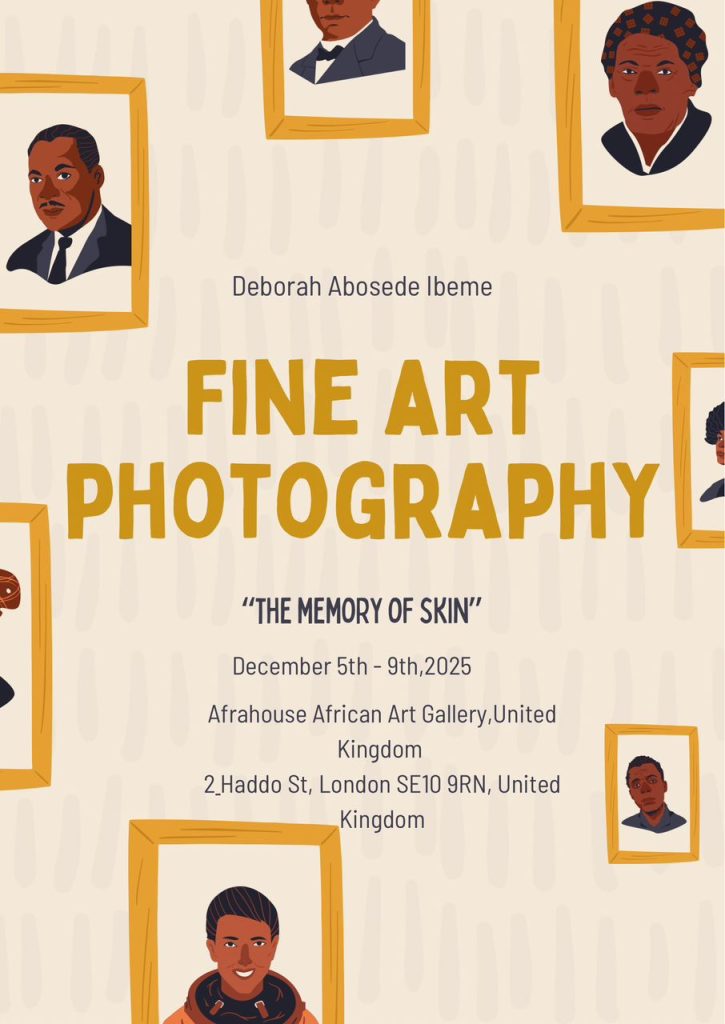
London, United Kingdom December 2025 Emerging visual storyteller Deborah Abosede Ibeme is set to present “The Memory of Skin,” a compelling fine art photography exhibition exploring identity, memory, culture, and the emotional stories carried through human experience. The exhibition will run from December 5th – 9th, 2025 at the Afrahouse African Art Gallery. Blending portraiture with cultural symbolism and emotional depth, “The Memory of Skin” invites audiences into a reflective visual journey that examines how history, heritage, and personal experiences are etched into the human body and spirit. Through carefully curated fine art photography pieces, Deborah Abosede Ibeme captures stories of resilience, beauty, identity, and belonging. Speaking ahead of the exhibition, Deborah described the project as “a conversation between memory and humanity a reminder that every face, every scar, every expression carries a story worth preserving.” The exhibition is expected to attract art lovers, photographers, collectors, creatives, and members of the African and international art community across the United Kingdom. Visitors will experience a thoughtful collection of works designed to spark dialogue around self-expression, cultural remembrance, and contemporary African artistry. Hosted at the Afrahouse African Art Gallery in London, the five-day exhibition aims to create an immersive atmosphere where art and storytelling intersect in meaningful and unforgettable ways. Exhibition Details Exhibition Title: The Memory of SkinArtist: Deborah Abosede IbemeDate: December 5th – 9th, 2025Venue: Afrahouse African Art GalleryAddress: 2 Haddo St, London SE10 9RN, United Kingdom Deborah Abosede Ibeme is a fine art photographer whose work focuses on emotional storytelling, identity, and cultural expression through contemporary portrait photography. Her artistic approach combines visual intimacy with thought-provoking narratives that celebrate human connection and memory.
The Woman Behind the Frame: Introducing Deborah Abosede Ibeme, the Nigerian Photographer Who Is Giving African Womanhood the Light It Always Deserved
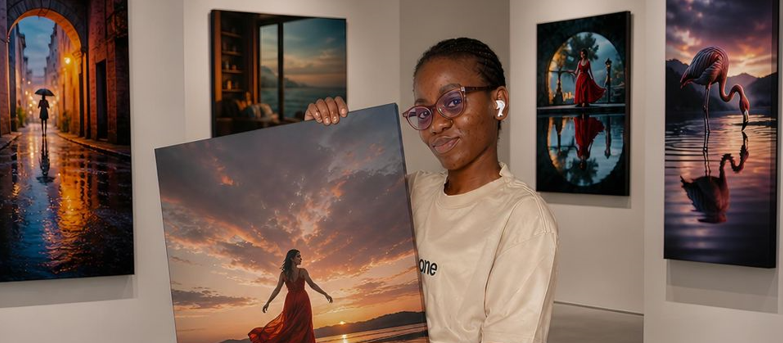
There are certain kinds of artists that do not just arrive, the kinds that accumulate.Slowly, deliberately, piece by piece, until the world turns around and finds them alreadythere. And you know another known fact? Warri does not produce passive people.There is particularly something in the air of that city, compressed, electric, layered withthe residue of a hundred different stories happening simultaneously, that either hardensyou or sharpens you. In the case of Deborah Abosede Ibeme, it did both. It gave her aneye that refuses to look away and a patience that refuses to be rushed. It gave her theunderstanding, early and without ceremony, that beauty in the Niger Delta is not adecoration. It is a survival strategy. It is a declaration. It is, sometimes, the only form ofdignity available. She was born into a family that understood this. Her household was one wherecreativity was not an elective, and both craftsmanship and cultural expression werepracticed the way other families practice prayer: regularly, seriously, with theunderstanding that something larger than the individual was being served. Thisenvironment did not make her an artist. But it made her someone who already knew,before she had the language for it, that the world could be arranged into meaning. Thatthe way something was presented was never separate from what it was saying. She came to photography through fashion and styling, and it wasn’t behind a camerabut beside it instead, developing the eye before she developed the hand. Sheunderstood proportion, symbolic weight, the grammar of adornment, what the choice ofa particular fabric against a particular skin at a particular angle could communicatewithout a single word. She eventually adopted the camera to formalize what she hadalready been doing for years in her mind. So, safe to say, unlike how a few others mayperceive, it was not a discovery. The turn toward fine art photography happened around 2019 and 2020, not as a studentmaking a first attempt, but as a woman making a considered choice about what hercreative life would be for. What drove that choice was absence. Don’t mistake it for a distance from the industrybecause she was already within it, already working. It was instead the absence she keptencountering in the images around her. The absence of the Niger Delta womanphotographed with the gravity she deserved. The absence of African “femininity” treatednot as texture or backdrop or cultural spectacle but as the full, complicated, spirituallydense subject of serious art. She had seen African women in front of lenses her entirelife. She had rarely seen them “seen”. Albeit that gap, it didn’t turn her bitter, she learned to become methodical. Sheunderstood that the answer to an absence is presence, not loud, not argumentative, butsustained and undeniable. She would produce work that made it impossible to continuethat particular oversight. She would build a body of work that did what she needed it todo: hold the Niger Delta woman in the light she was always owed. Deborah began professionally in 2020. Within two years, her work was on the walls ofthe Nike Art Gallery in Lagos which is one of Nigeria’s most significant culturalinstitutions, as part of her solo exhibition “Where Ancestors Still Breathe.” The title wasnot poetic decoration. It was a declaration of the philosophy that would anchoreverything she would produce: the past is not behind us. It is inside us. It breathesthrough us. And if you look carefully enough, you can photograph it. A Deborah Abosede Ibeme photograph does not feel taken. It feels made following thedeliberate assemblage of a sculptor, and the precision of someone who understandsthat every element in the frame is either earning its place or undermining the whole.She works primarily in studio environments she designs herself, building sets fromhand-sourced traditional fabrics, ritual objects, clay vessels, cowrie shells, and symbolicmaterial drawn from the cosmological traditions of the Niger Delta. The Ijaw water deity,the Urhobo masquerade, the ancestral feminine. She is fluent in what they mean andinsistent on using them correctly. Her subjects are not models in the commercial sense. They are women she selects withthe precision of a casting director who is also a cultural historian. Women whose faces,postures, and presences carry the specific weight the work requires. Before the camerais shot, she spends significant time simply with them. She speaks little during sessions,not an awkward silence. It’s with it that she builds the conditions in which something truecan happen. According to Deborah, she shoots between 200 and 400 frames per session, selectswith a severity that would unnerve most photographers. She acknowledges that a fullday of production might yield only one final image. Occasionally two, which she doesn’tconsider wasteful but honest. By 2026, Deborah Abosede Ibeme has produced over fifteen major conceptualphotography series, each a sustained, thematically coherent examination of onedimension of African womanhood, cultural inheritance, or spiritual identity. She hasmounted solo exhibitions across Nigeria and the United Kingdom: from the ThoughtPyramid Art Centre in Oghara to the CasildART Gallery in London, from TessArt Galleryin Asaba to the African Centre in London. She has participated in group exhibitions onfour continents; New York, Nairobi, Ghana, Dubai, Uganda alongside some of the mostcompelling voices in contemporary African visual art. Her gallery works; Strength of The River Mother, Under the Ancestral Moon, Veiled Majesty, The Good Effect, Grace Between the Stalls, are priced between $4,500and $5,500 and held in private collections across Nigeria, the United Kingdom, theUnited States, and Canada. These are not decorative purchases. Her collectors arepeople who acquire art because it holds something they cannot find elsewhere, aparticular truth, recognition, or weight. She has received recognition from institutions that matter: the Delta State Fine ArtPhotography Awards, the Ministry of Art and Tourism Nigeria Photography Prize, theNational Emerging Artist Award (shortlisted at Studio24, Lagos), a Merit Award from theUnited Bank for Africa, and the Rising Talent Recognition from the Niger-Delta CreativeArts Platform. Each of these honors arrived not as a surprise but as a confirmation —the industry catching up with what the work had already said. She has directed visual productions for cultural institutions including the Asaba Museumand the