

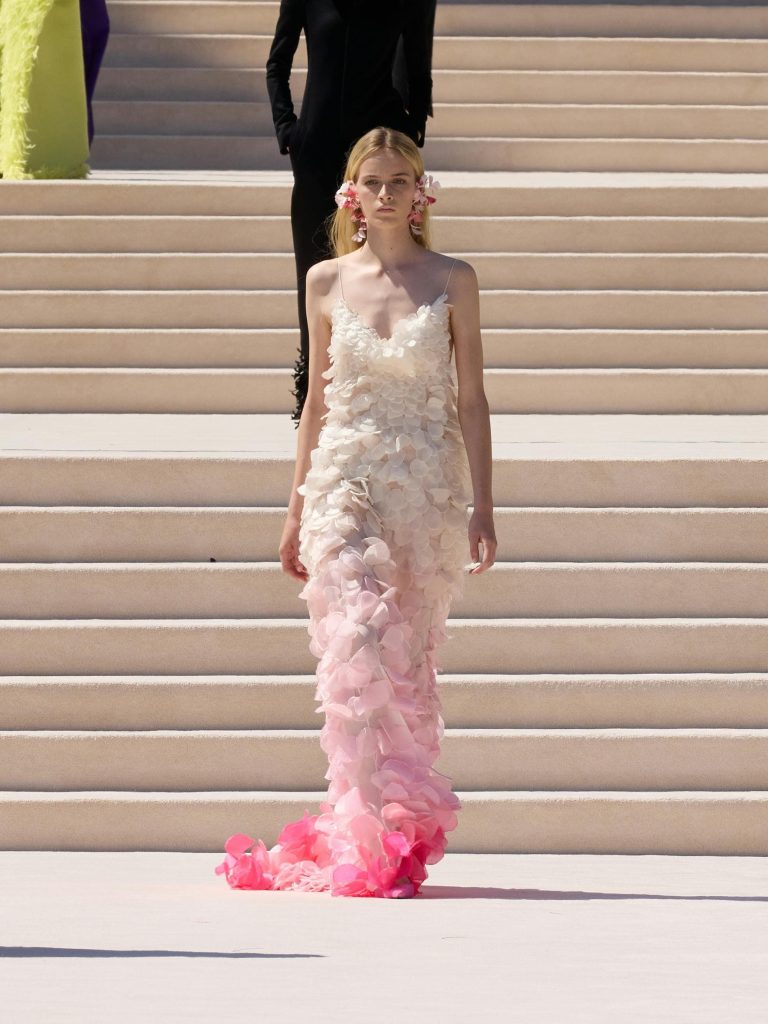
There are couture debuts that lean heavily on nostalgia, and then there are those that quietly reshape a house’s future. Pierpaolo Piccioli chose the latter for his first haute couture collection at Balenciaga, presenting a debut that honoured Cristóbal Balenciaga’s uncompromising vision while refusing to become trapped by it.
Presented during Paris Haute Couture Week at the Cité Internationale Universitaire de Paris, the collection unfolded less as a retrospective and more as a conversation across generations. Rather than reproducing familiar silhouettes, Piccioli revisited the principles that made Balenciaga revolutionary: sculptural volume, architectural precision and an unwavering belief that clothing should transform the relationship between body and garment.
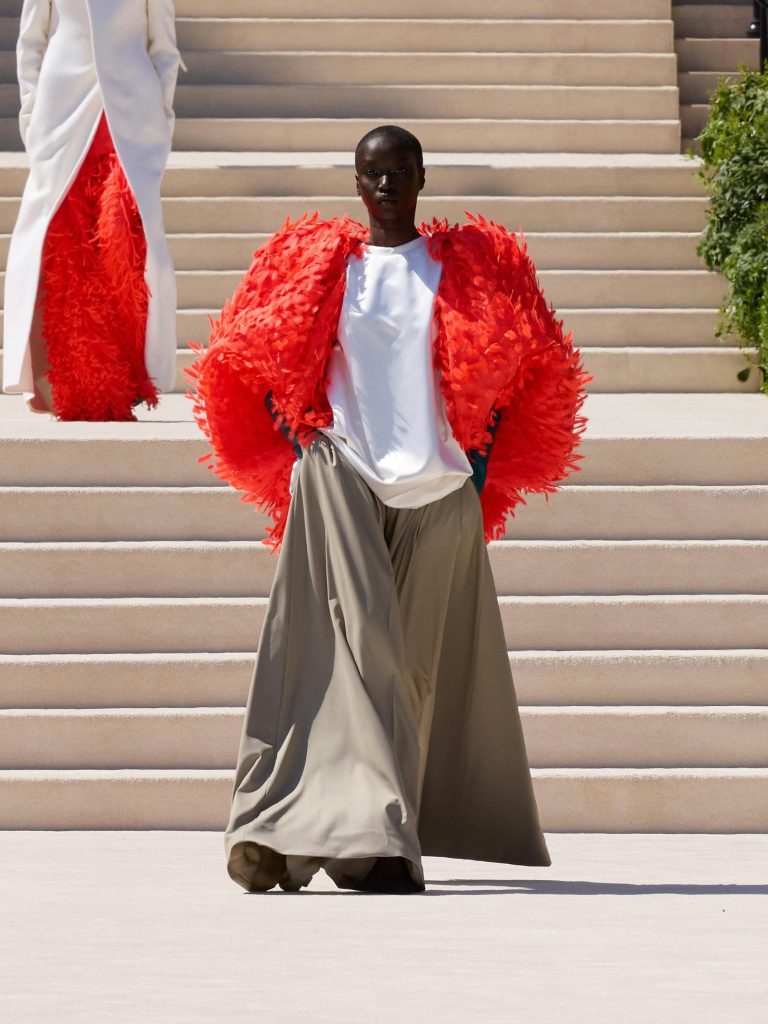
The opening look made that intention unmistakably clear. A crisp white silk T-shirt tucked into relaxed beige wool trousers, finished with an oversized orange feathered cape, swept away any expectation that the collection would begin with the house’s signature black. It was a gesture of confidence rather than rebellion—an invitation to view Balenciaga through a different lens.
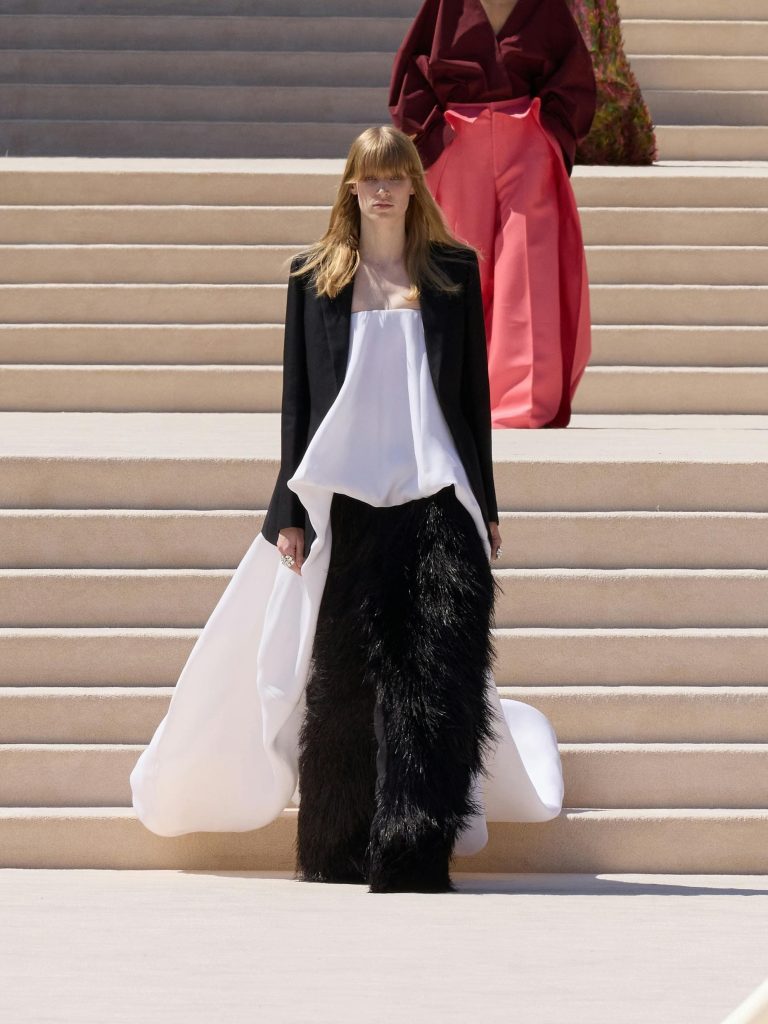
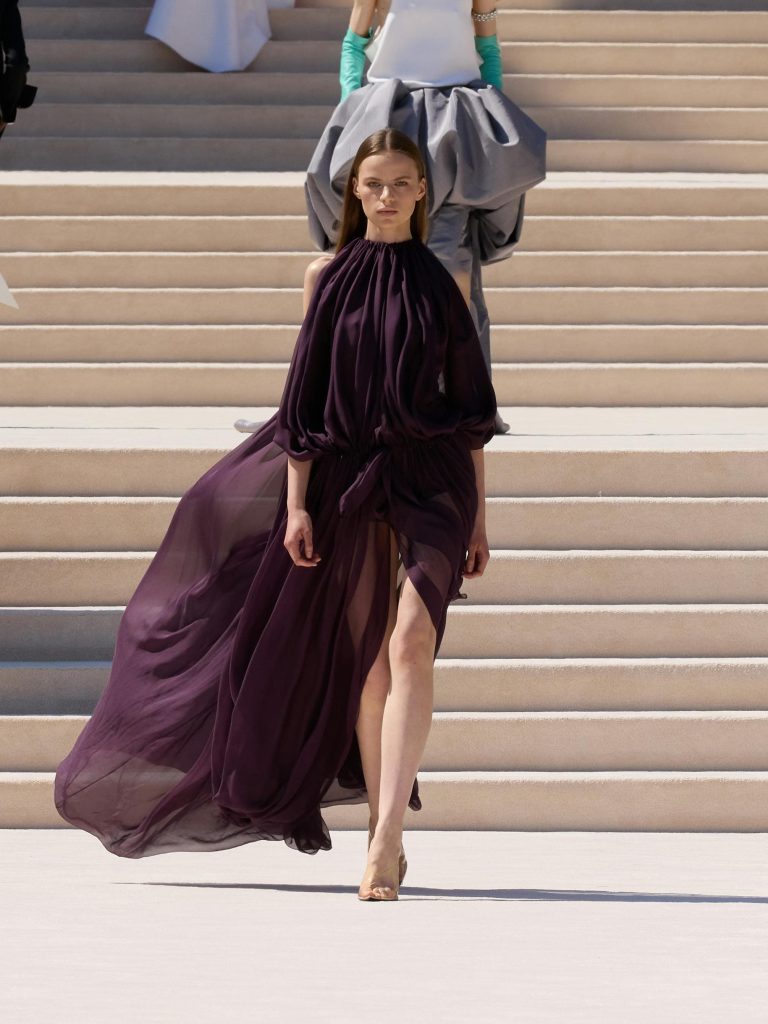
Throughout the collection, restraint and extravagance coexisted with remarkable ease. Tailored cashmere coats, fluid silk separates and elongated evening silhouettes were engineered with extraordinary precision, yet never appeared burdened by technique. Instead, garments seemed to float around the body, creating movement without relying on traditional couture foundations such as rigid corsetry or heavy internal structures.
That illusion of effortless construction became one of the collection’s greatest achievements. Three-dimensional body scanning allowed coats and dresses to mould naturally to the wearer, while innovative materials including bio-engineered AMSilk introduced a modern dimension to Balenciaga’s couture vocabulary. Technology, however, never overshadowed craftsmanship. It simply became another tool in the atelier’s pursuit of purity.
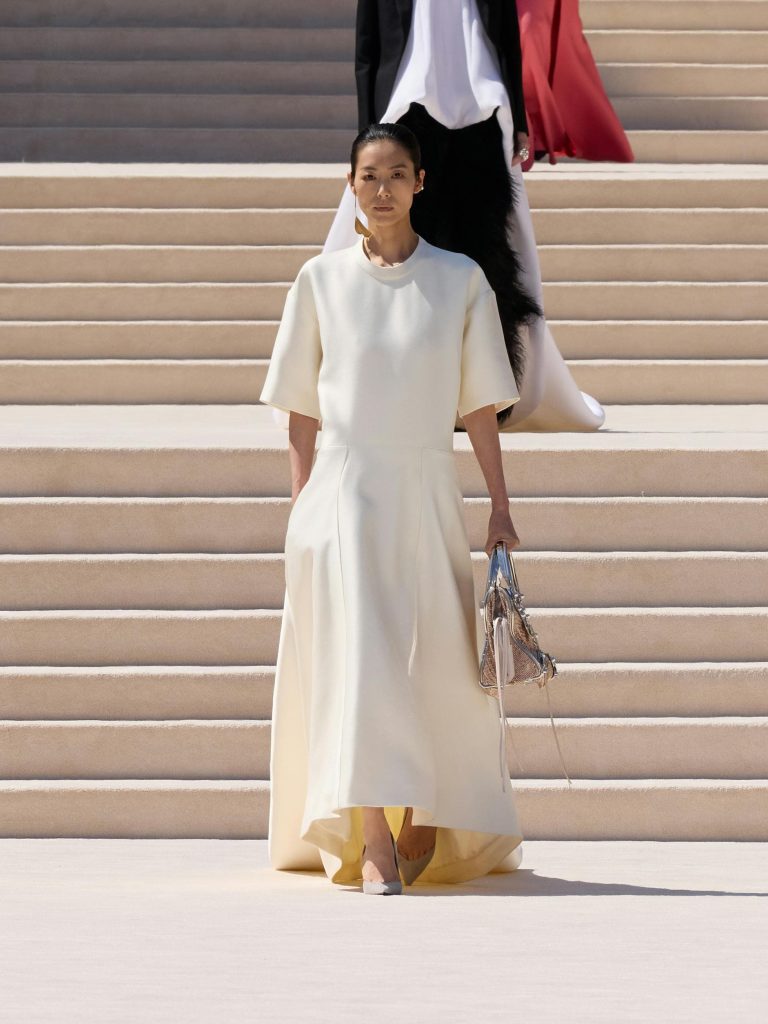
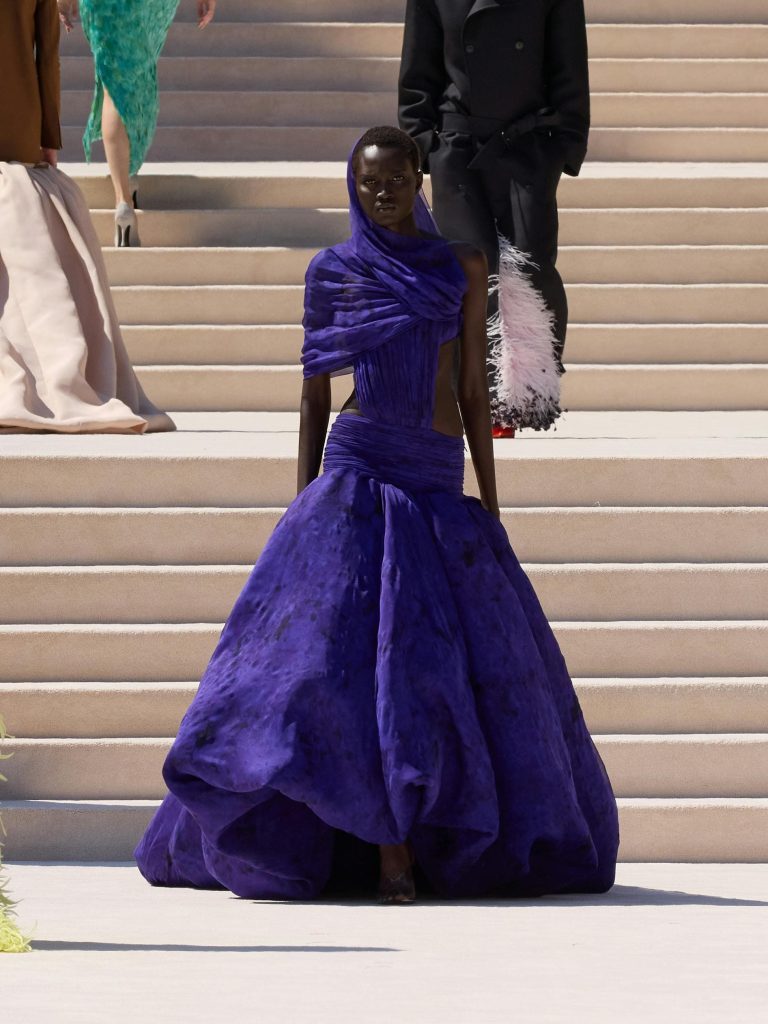
Piccioli’s fascination with volume emerged through ballooning capes suspended weightlessly over the shoulders, sweeping trains that trailed behind silk gazar gowns, and sculptural tailoring that expanded outward before collapsing gracefully back toward the body. Feathers, meanwhile, were treated less as embellishment than architecture. They softened silhouettes, redefined proportion and introduced unexpected movement without sacrificing structural clarity.
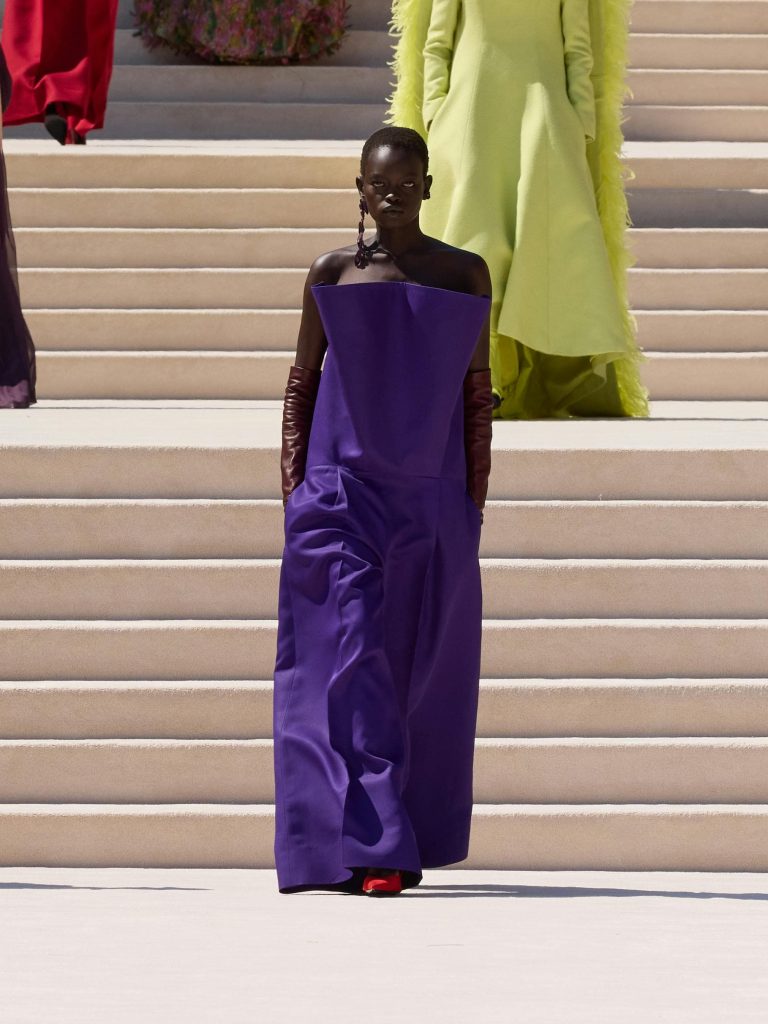
Several looks distilled this philosophy beautifully: a strapless gown embroidered with multicoloured silk feathers; a sharply sculpted dark-purple jumpsuit softened by fluid lines; an anise-green bouclé coat revealing an organza-framed open back; and an ivory monastic gown whose monumental train appeared carved rather than sewn.
If one image is likely to define the collection, it belongs to Gigi Hadid. Emerging beneath an enveloping cloud of black feathers created with renowned milliner Philip Treacy, she embodied the duality running throughout the show—protection and vulnerability, sculpture and softness, fantasy and functionality. Beneath the dramatic headpiece sat relaxed green tailoring, grounding the look firmly in modernity.
The collection repeatedly returned to this balance between control and emotion. Piccioli never abandoned the discipline synonymous with Balenciaga, but he introduced a gentleness rarely associated with the house’s couture history. Colour punctuated the predominantly restrained palette in flashes of orange, lilac, blush pink and deep crimson, reminding viewers that drama need not always announce itself loudly.
Speaking after the presentation, the designer explained that recreating Cristóbal Balenciaga’s silhouettes was never his ambition. Instead, he sought to understand the methods and philosophies that shaped them before applying those principles to contemporary life.
That thinking was perhaps most evident in the show’s closing moments. Rather than stepping out alone, Piccioli invited Balenciaga’s atelier artisans onto the runway beside him, all dressed in white work coats. The prolonged standing ovation that followed felt directed as much toward the craftsmen behind the collection as the designer himself—a fitting conclusion for a house whose greatest luxury has always been the hands that build its creations.
Among those watching from the front row were Cate Blanchett, Lily Collins, Demi Moore, Cynthia Erivo, Naomi Watts, Jodie Turner-Smith, Li Bingbing, Hugo Ekitike and Kering chief executive Luca de Meo, witnessing what felt less like a debut than the beginning of a carefully considered new era.
Rather than rewriting Balenciaga’s history, Piccioli expanded its language.