

Clothed in Care, a Solo Exhibition by Goodluck JaneKampala, Uganda.
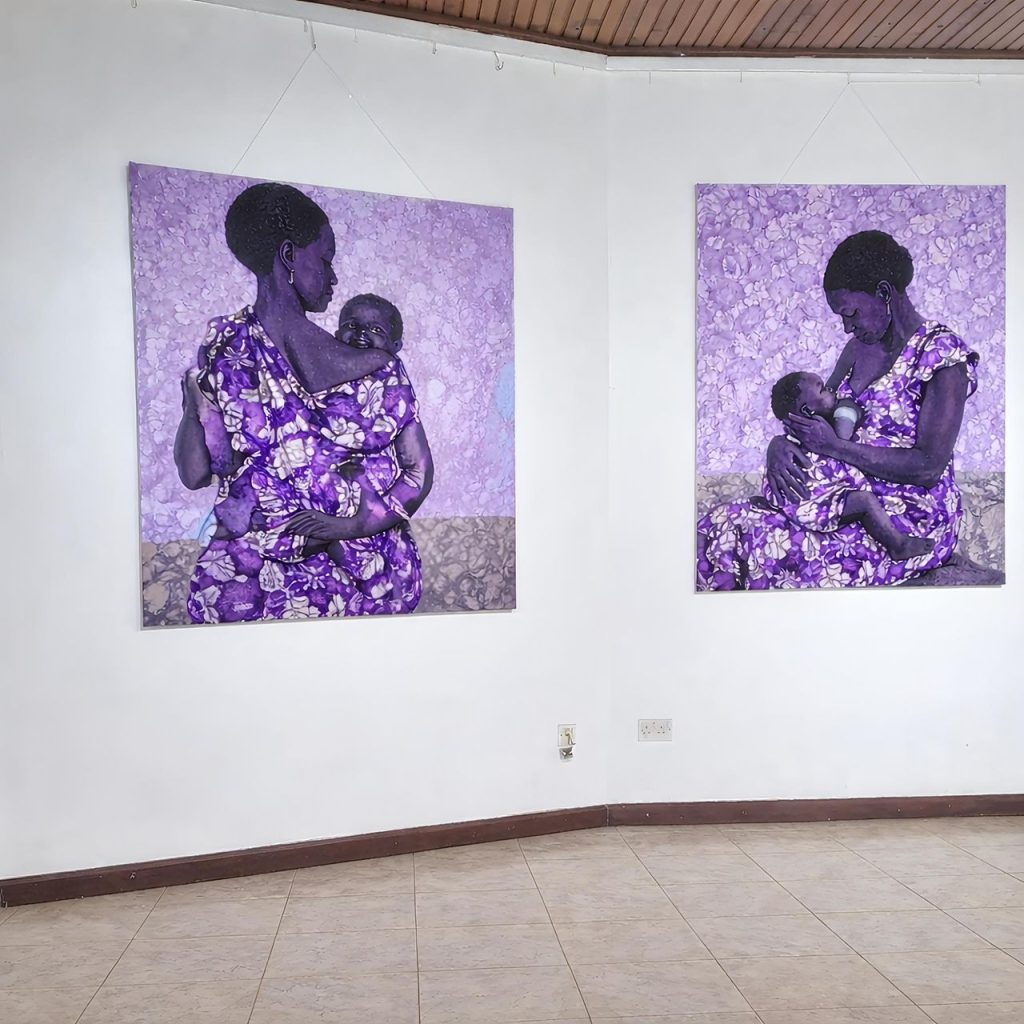
Umoja Art Gallery has concluded Clothed in Care, a solo exhibition by Goodluck Jane, presented from January 12 to January 17, 2025. The week-long exhibition brought together artists, cultural practitioners, guests, collectors, and members of the public to reflect on clothing and textiles as materials shaped by care, memory, and responsibility. In Clothed in Care, Goodluck Jane explored clothing as something lived with rather than simply worn. Through her work, textiles emerged as quiet witnesses to everyday life holding stories of protection, motherhood, inheritance, ritual, and emotional connection. Her practice positioned cloth as unique , also as a material that carries time, labour, and human intention. The exhibition focused on hands-on textile processes such as stitching, layering, mending, and reconstruction. These actions drew attention to care as a physical and ongoing practice that requires patience and commitment. By emphasizing process, Jane highlighted the unseen work involved in making and maintaining cloth, connecting it to broader histories of caregiving and domestic labour. Clothed in Care also raised questions about how clothing is valued today. In contrast to fast fashion and disposability, the exhibition foregrounded reuse, preservation, and emotional attachment to garments. Many visitors reflected on their own relationships with clothing how items are cared for, passed down, or discarded, and what these choices reveal about responsibility and connection. Beyond individual reflection, the exhibition opened wider conversations about culture and community. Jane’s work linked textile practices to both domestic and communal spaces, showing how clothing connects people across generations. Discussions during the exhibition touched on traditional knowledge, gendered labour, sustainability, and the role of craft in maintaining cultural continuity. By centering textile labour that is often overlooked or undervalued, Clothed in Care drew attention to the everyday actions that quietly sustain families and communities. This focus resonated strongly with audiences, particularly in relation to motherhood and caregiving as forms of ongoing, embodied care. Through this solo exhibition, Umoja Art Gallery reaffirmed its commitment to supporting artists whose work is rooted in lived experience and social reflection. Clothed in Care offered visitors a space not only to view art, but to think, feel, and engage in meaningful conversation. As the exhibition concludes, Clothed in Care stands as a thoughtful contribution to contemporary discussions around textile practice, memory, and responsibility. Through fabric, labour, and quiet gestures of care, Goodluck Jane’s work reminds us that clothing is not just something we wear it is something we live with, remember through, and care for over time.
Clothed in Care: Goodluck Jane Examines Care as Inherited Labour at Solo Exhibition.

Care is work long before it is ever named. It is learned through repetition, absorbed through proximity, and practiced quietly within domestic spaces. In Clothed in Care, visual artist Goodluck Jane presents a considered and material-led exploration of care as emotional, cultural, and inherited labour, carried not through language but through fabric, gesture, and routine. The solo exhibition will be presented at Umoja Art Gallery, Kampala, from January 12 to 17, 2025, bringing together a body of mixed media works that focus on how care operates within African domestic environments. Through drawing, painting, and the deliberate use of Ankara fabric, Jane centers material as an active witness to responsibility, intimacy, and time. In this exhibition, fabric is not symbolic. It is lived. Ankara appears as a carrier of memory, holding the residue of touch, maintenance, and obligation. It remembers what the body forgets. Jane’s work isolates ordinary, often overlooked gestures dressing another person, preserving clothing beyond its original use, using fabric for protection, comfort, or restraint and insists on their significance. These actions are repetitive and uncelebrated, yet they form the unseen structure of care within families and communities. Material functions as both subject and language. Familiar across African societies, Ankara fabric carries associations of labour, continuity, and belonging. Jane cuts, layers, and positions the textile with restraint and precision. Pattern and texture guide the viewer without excess. Nothing in the work is decorative; every element is purposeful, reinforcing care as an active and sustained responsibility rather than a passive emotion. Jane’s background in fashion design informs her disciplined approach. She understands fabric as something constructed, handled, worn, and maintained over time. This technical knowledge is combined with a visual art practice rooted in clarity and control, resulting in works that are grounded and deliberate. Each decision reinforces the exhibition’s central concern: care as something practiced daily, held in the body, and carried across generations. Figures within Clothed in Care appear in moments of closeness and pause. There is no spectacle or dramatization. Instead, Jane focuses on proximity, dependence, and trust. Stillness becomes a site of meaning, asking viewers to slow down and attend to surface, weight, and gesture. The works reward patience, offering depth through quiet observation. The exhibition also addresses how care is inherited. Many ways of caring are never explicitly taught; they are absorbed through watching and doing. Fabric becomes an archive of this transmission, recording family life, labour, and emotional exchange through use and wear. Presenting Clothed in Care in Kampala is significant. The city’s strong relationship with making, material knowledge, and storytelling provides a context in which the work can be deeply understood. Umoja Art Gallery’s commitment to contemporary African practice creates space for critical conversations around material culture, identity, and lived experience. By positioning textile as a primary medium, Jane contributes to wider discussions around fabric in contemporary visual art, disrupting traditional distinctions between art, craft, and design. Her work asserts textile as a critical, narrative-driven material capable of carrying complex emotional and cultural meaning. Clothed in Care forms part of Goodluck Jane’s expanding international practice and reflects a focused stage in her work marked by confidence, restraint, and a clear commitment to material-led storytelling. Visitors are not met with spectacle, but with presence. The exhibition offers space to consider how care shapes identity, how it is passed down quietly, and how ordinary materials hold the weight of emotional life.
Age Series, a Solo Exhibition by Mavic Chijioke Okeugo

Mavic Chijioke Okeugo is ready for his solo exhibition Age Series, on view from November 4–9, 2024 in Accra, Ghana Gallery 1957. Age Series is a powerful body of photographic work that centers on intimate portraits of elderly men and women. Through a refined visual language and an empathetic lens, Okeugo explores aging as a site of dignity, memory, and resilience. The series challenges conventional representations of older bodies, offering instead images that celebrate presence, depth, and lived experience. Rooted in portraiture, Age Series reflects on the passage of time and the narratives carried by those who have lived long lives. Each photograph serves as a quiet encounter, inviting viewers to pause and consider the emotional and cultural significance of aging within both African and global contexts. The exhibition will be presented within Gallery 1957’s contemporary exhibition space, providing an intimate setting that encourages close engagement with the works. Audiences can expect a thoughtful and immersive experience that foregrounds human connection and storytelling. Age Series marks an important moment in Okeugo’s practice, reinforcing his ongoing interest in identity, visibility, and representation through photography. The exhibition also aligns with Gallery 1957’s commitment to showcasing artists whose work engages critically with social and cultural narratives. The public is invited to experience Age Series from November 4–9, 2024 at Gallery 1957, Accra. Exhibition DetailsArtist: Mavic Chijioke OkeugoExhibition: Age SeriesDates: November 4–9, 2024Venue: Gallery 1957, Accra, Ghana
Goodluck Jane Presents Solo Exhibition Ankara Stories

Contemporary visual artist Goodluck Jane will present her highly anticipated solo exhibition, Ankara Stories, at the African American Atelier Gallery, USA, from November 17th to 21st, 2024. The exhibition marks a significant milestone in the artist’s growing international career and introduces a powerful new body of work to U.S. audiences. Ankara Stories features a compelling series of mixed-media artworks that explore African identity, memory, and everyday lived experiences through the expressive use of Ankara fabric. Rather than treating fabric as ornamentation, Goodluck Jane positions textile as a narrative language one that carries history, emotion, and cultural meaning. Working across painting, drawing, and textile-based media, the artist constructs each piece through meticulous layering of cut Ankara textiles, paper, and hand-drawn elements. The resulting compositions center on the human figure and intimate moments of daily life, reflecting how fabric is woven into family, community, and shared cultural memory. The works are tactile, emotionally resonant, and deeply rooted in personal and collective storytelling. Goodluck Jane’s artistic approach is shaped by her background: she comes from a family of painters and drawing artists and later received formal training in fashion design. This dual foundation informs her sensitivity to material, structure, and detail, allowing her to merge technical precision with expressive depth. In Ankara Stories, fabric becomes both medium and message speaking to heritage, resilience, and identity beyond its surface beauty. This exhibition represents an important presentation of Goodluck Jane’s work in the United States and builds on her expanding exhibition history across Africa and internationally. Ankara Stories invites viewers into a visual dialogue that is at once personal and universal, honoring African narratives through contemporary artistic expression. The exhibition will be open to the public at African American Atelier Gallery, USA, from November 17th to 21st, 2024.
Marvic Chijioke Okeugo Joins Photo Garage Lagos Artists Network, Elevating Professional Photography in Nigeria

Photographer Marvic Chijioke Okeugo joined the Photo Garage Lagos Artists Network (PGLAN) September 18th 2024, integrating into a professional community committed to fostering excellence, collaboration, and innovation in Nigerian photography. His membership underscores his dedication to advancing visual storytelling and contributing to the growth of the country’s photographic arts sector. Photo Garage Lagos Artists Network serves as a platform for professional photographers across Lagos and Nigeria, offering opportunities for exhibitions, skill development workshops, mentorship, and collaborative projects. The network aims to strengthen the standards of professional photography while providing a platform for emerging and established photographers to engage, innovate, and gain wider recognition. Marvic’s photography aligns with PGLAN’s objectives by capturing cultural narratives, urban experiences, and social realities through compelling imagery. His work demonstrates the power of photography as a medium for storytelling, cultural documentation, and societal reflection. The network features distinguished photographers who have significantly impacted Nigeria’s photography landscape. Notable members include Jide Alakija, renowned for his innovative portraiture and commercial photography; Aisha Augie-Kuta, acclaimed for documenting cultural and social narratives; and George Osodi, whose photojournalistic work captures Nigeria’s socio-political developments. Their achievements reflect PGLAN’s commitment to nurturing professionalism, creative excellence, and social relevance in photography. By joining PGLAN, Marvic Chijioke Okeugo becomes part of a collaborative network that promotes professional growth, mentorship, and the visibility of Nigerian photographers. His membership reinforces his commitment to photography as both an artistic practice and a tool for cultural storytelling, engagement, and the advancement of Nigerian creative arts on national and international stages.
RELE GALLERY LOS ANGELES ANNOUNCES “UZO ANYA,” A SOLO EXHIBITION BY MAVIC CHIJIOKE OKEUGO
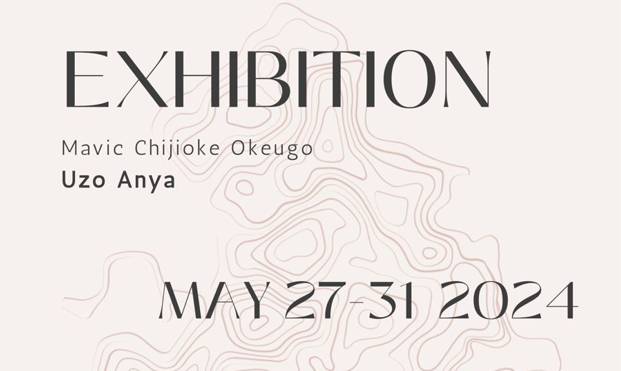
Rele Gallery, Los Angeles, is pleased to announce Uzo Anya, a highly anticipated solo exhibition by Nigerian visual artist Mavic Chijioke Okeugo, opening May 27, 2024, and on view through May 31, 2024. The exhibition marks Okeugo’s first solo presentation in Los Angeles and introduces a powerful new body of work that interrogates vision, perception, and cultural memory through contemporary fine art photography. Uzo Anya, an Igbo phrase meaning “the way of the eye” or “the path of seeing,” serves as both the conceptual and philosophical anchor of the exhibition. Through meticulously constructed images, Okeugo explores how Black bodies—particularly Igbo women—are seen, remembered, and positioned within historical and contemporary visual narratives. The works challenge passive looking, instead inviting viewers into a reciprocal encounter where the gaze is returned with clarity and intent. The exhibition features large-scale photographic works that blend documentary precision with painterly depth. Drawing from Igbo symbolism, ritual adornment, and ancestral presence, Okeugo creates images that exist between past and present, tradition and contemporary expression. Coral beads, textured surfaces, and controlled lighting function as visual language—signifiers of identity, dignity, and continuity. Presented in Rele Gallery’s Los Angeles space, Uzo Anya positions African photography beyond ethnographic framing, asserting it as a site of conceptual rigor and emotional resonance. The exhibition aligns with Rele Gallery’s ongoing commitment to amplifying African and diasporic voices within global art discourse. Speaking ahead of the opening, Okeugo notes that Uzo Anya is an invitation to reconsider how we look and what it means to truly see beyond surface representation and toward deeper cultural understanding. The opening reception will take place on May 27, 2024, welcoming collectors, curators, press, and the public to engage with this compelling body of work.
Threads That Remember: Goodluck Jane Wraps Up a Week In London
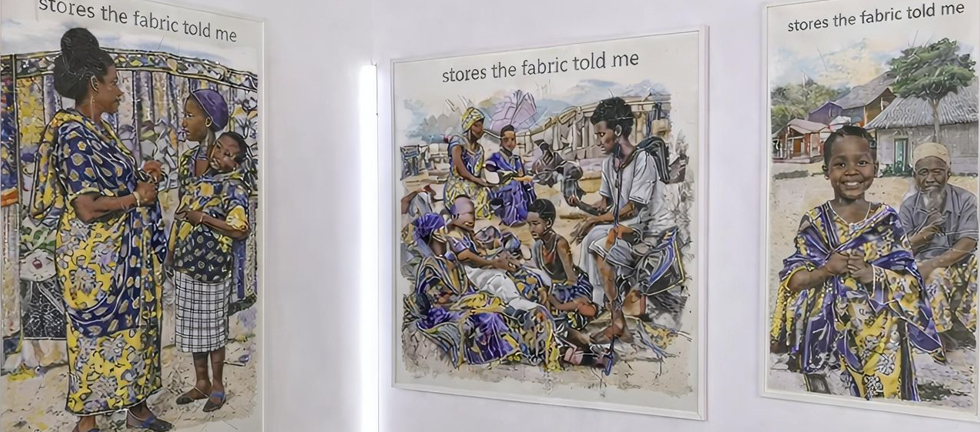
By the final afternoon, the room felt lived in like the works had settled into the walls and the conversations they sparked were reluctant to leave. Stories the Fabric Told Me, a solo presentation by Goodluck Jane, ran from May 5 to 12, 2024 at Casildart Gallery. Over the course of the week, the exhibition drew a steady mix of visitors collectors, curators, curious passersby each spending time with paintings that seemed to ask for more than a quick glance. Jane’s focus was deceptively simple: fabric. But in her hands, cloth became something else entirely. Not just material, but memory. Not just pattern, but presence. Across the gallery, figures gathered in quiet, intimate scenes women seated together, children leaning into elders, moments that felt both specific and familiar. The textiles in these works did more than dress the subjects; they anchored the stories. Every fold, every repeated motif carried weight, hinting at histories stitched into everyday life. There was a rhythm to the exhibition. Patterns echoed across canvases like refrains, suggesting continuity between generations, across geographies, through time. Viewers often lingered, tracing those visual repetitions as if trying to read them aloud. The title itself Stories the Fabric Told Me set the tone. It wasn’t about loud declarations. It was about what’s passed along quietly: what clothing witnesses, what it absorbs, what it remembers long after moments have gone. Reactions throughout the week leaned personal. Some spoke about being reminded of home, of family wardrobes, of fabrics tied to ceremonies and milestones. Others were drawn to the tension between past and present the way the work felt rooted in tradition while still firmly contemporary. Collectors responded quickly, with several pieces finding new homes before the exhibition closed. But beyond that, the show seemed to resonate on a more reflective level, opening up conversations around heritage, storytelling, and the ways culture is carried without always being spoken. Jane described the project as an attempt to listen to the quiet narratives embedded in cloth. In her words, textiles don’t just accompany life, they bear witness to it. Her paintings take that idea seriously, fixing those fleeting, often overlooked stories into something lasting. As the exhibition came to an end, what remained wasn’t just the memory of the works, but the feeling they left behind soft, persistent, and difficult to shake.
Goodluck Jane Presents Fabric of Our Stories Solo Exhibition
Goodluck Jane solo exhibition The Africa Center Gallery, USA, will present Fabric of Our Stories, a solo exhibition by multidisciplinary visual artist Goodluck Jane. The exhibition brings together textile, painting, and mixed media works that explore how fabric holds memory, culture, and identity. In Fabric of Our Stories, Jane uses Ankara fabric as more than a surface or design element. For her, fabric is a storyteller. It carries family histories, shared traditions, and everyday experiences passed from one generation to the next. Through personal memories and broader African cultural references, Jane shows how cloth connects the body, the home, and the community. The artworks combine cut fabric, paint, and drawing in layered compositions. Figures, patterns, and abstract forms appear side by side, creating works that feel both intimate and expressive. Each piece is carefully built stitched, layered, and marked with intention inviting viewers to slow down, look closely, and discover new details with time. Jane’s background in fashion design plays an important role in her practice. Her understanding of fabric, pattern-making, and construction gives her work structure and precision. At the same time, the pieces are deeply emotional and personal. They speak about memory, care, labor, and the quiet beauty found in daily life. At the center of the exhibition is the idea of continuity how stories, identities, and values are carried forward. Jane reflects on how fabric holds traces of touch, movement, and routine. Clothing and textiles become witnesses to life, holding moments that words often cannot. Some works focus on domestic spaces and family scenes, capturing everyday rituals and gestures. Others show bodies in motion, emphasizing connection, shared experience, and lineage. Ankara patterns appear repeatedly, symbolizing inherited culture, belonging, and collective memory. Fabric of Our Stories also draws attention to craft and labor. By highlighting the time and care involved in working with fabric, Jane invites viewers to notice the meaning embedded in ordinary materials. The exhibition encourages reflection on what we often overlook the stories woven into the things we live with every day. This exhibition marks an important moment in Jane’s growing international practice. Since beginning her professional journey in 2021, she has exhibited across Africa, Europe, and the United States, gaining recognition for her thoughtful use of textiles and materials. Fabric of Our Stories presents a focused and mature body of work that reflects her artistic growth. Visitors can expect an immersive and thoughtful experience one that goes beyond looking at art to feeling it. The exhibition asks simple but powerful questions: What do we carry with us? How do everyday materials hold our stories? And how does fabric connect us across time and place? Fabric of Our Stories will be on view at The Africa Center Gallery, USA, from March 11–15, 2024. The exhibition invites audiences to engage with art that is personal, cultural, and deeply rooted in lived experience.
Bloodline in Bold Print, A Solo Exhibition by Goodluck Jane Kampala, Uganda!
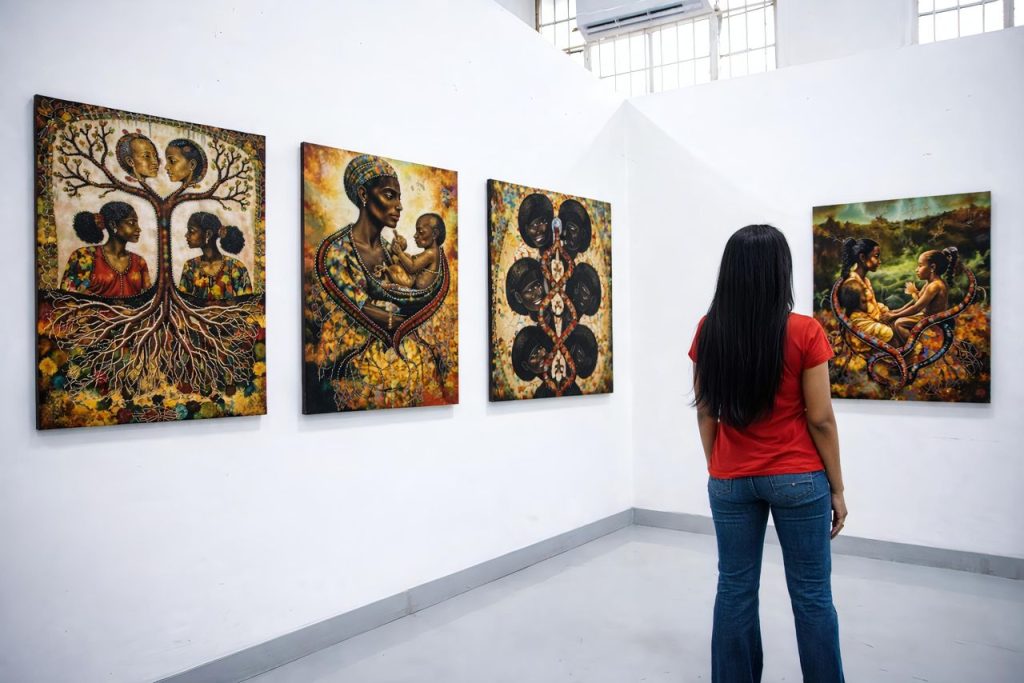
A successful conclusion of Bloodline in Bold Print, a solo exhibition by Nigerian multidisciplinary visual artist Goodluck Jane at the Afriart Gallery , which was presented at the gallery’s Kampala space from October 1 to October 7, 2021. The exhibition offered audiences an immersive and thought-provoking engagement with themes of ancestry, memory, identity, and the layered legacies that shape both personal and collective experience. From the opening day, Bloodline in Bold Print invited visitors into a richly textured visual environment where African textiles particularly Ankara were transformed into powerful vessels of history and narrative. Through bold patterns, layered surfaces, and mixed-media compositions, Jane encouraged audiences to pause and reflect on how cultural memory and personal history are woven into everyday materials, gestures, and symbols. Throughout its week-long run, the exhibition attracted a diverse audience of artists, collectors, curators, cultural scholars, students, and members of the public. The gallery space became a vibrant site of dialogue and exchange, with visitors drawn to Jane’s striking visual language and the conceptual depth of her practice. Many noted how the works functioned as living archives—capturing stories of lineage, inheritance, and identity that traverse generations—while simultaneously expressing the energy and complexity of contemporary life. Central to the exhibition was Jane’s exploration of inheritance beyond the biological. Her works illuminated emotional, social, and cultural legacies that are often unspoken yet deeply influential. Through repetition, layering, and pattern, the compositions visually echoed the processes by which traditions are preserved, questioned, and transformed over time. Visitors remarked on how the works captured the tension between continuity and change, reflecting the ongoing negotiation of identity within families, communities, and broader social structures. The interplay between body and textile emerged as a defining element of the exhibition. Figures appeared entwined with fabric in ways that suggested intimacy, protection, and continuity, positioning garments as extensions of the self almost like second skins imbued with memory and history. These works emphasized the body as an active participant in memory-making, underscoring the idea that identity is lived, worn, and continually shaped by inherited narratives and personal experience. Afriart Gallery complemented the exhibition with guided tours, artist talks, and interactive sessions that allowed visitors to engage more deeply with Jane’s research and practice. These programs offered insight into her study of African textiles and their social, emotional, and cultural significance, while opening space for discussion around lineage, memory, and identity in contemporary African art. Jane’s presence throughout the exhibition fostered meaningful dialogue and provided audiences with a rare opportunity to connect directly with the artist’s process and perspectives. Public response to Bloodline in Bold Print underscored its emotional and conceptual impact. Many visitors shared that the works prompted personal reflection on their own family histories and cultural inheritances, while also encouraging broader conversations about collective memory and social legacy. The exhibition resonated not only for its visual richness, but for its ability to connect individual experience with shared cultural narratives. Through Bloodline in Bold Print, Afriart Gallery reaffirmed its commitment to presenting contemporary African artists whose practices engage critically with history, culture, and lived experience. By foregrounding African textiles as both material and metaphor, Goodluck Jane created a body of work that bridged the personal and the communal, the past and the present. The exhibition stands as a testament to Jane’s artistic vision and mastery, and to the power of contemporary African art to foster dialogue, reflection, and deeper understanding. Afriart Gallery celebrates the success of Bloodline in Bold Print and its lasting impact on audiences, marking it as a significant contribution to ongoing conversations around memory, lineage, and identity in contemporary art.
Fabric of Our Stories
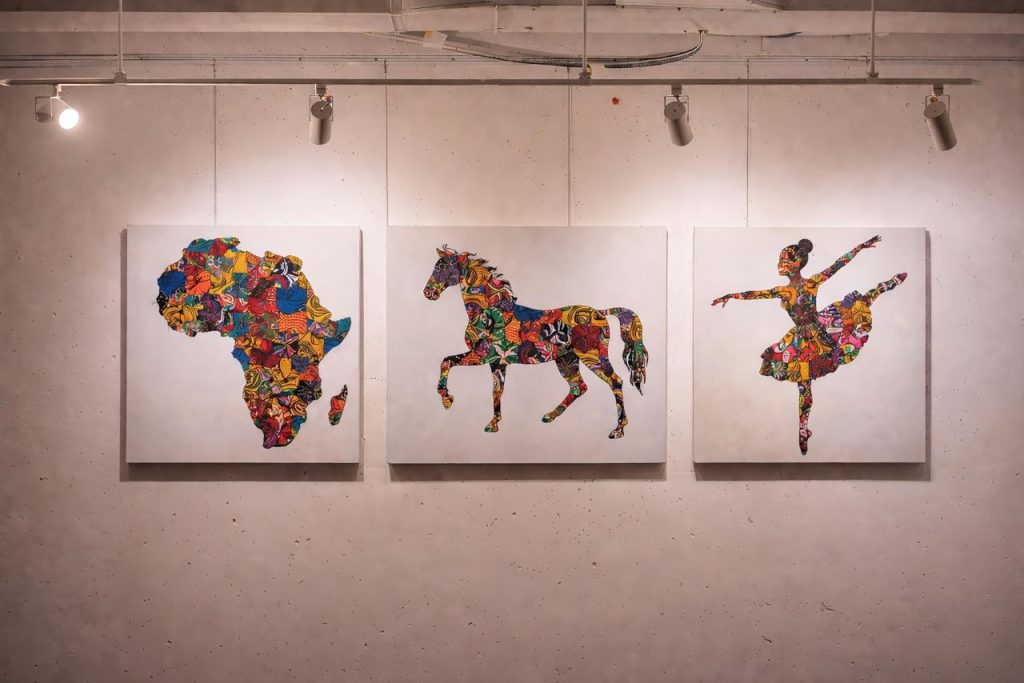
“Fabric of Our Stories” came to a close at The Africa Center Gallery, USA, after a powerful five-day presentation from March 11–15, 2024. The solo exhibition by multidisciplinary visual artist Goodluck Jane drew a steady flow of visitors and created a quiet but lasting impression through works that spoke plainly, deeply, and without excess. The exhibition featured mixed media artworks built from Ankara fabric, drawing, and paint. Each piece used fabric not as decoration, but as substance cut, layered, and shaped to carry memory. Figures, symbols, and forms emerged from patterned cloth, reflecting family ties, movement, ancestry, and shared cultural life. The works felt familiar yet personal, inviting viewers to slow down and look closely. Audiences responded strongly to this approach. Many visitors spent time with each piece, tracing the edges of fabric, noticing how colors met, how figures stood or moved. The experience was intimate rather than overwhelming. The stories unfolded quietly, allowing space for personal connection and reflection. The gallery welcomed a wide range of visitors throughout the exhibition period, including artists, curators, educators, students, collectors, and members of the African diaspora. The opening days saw creatives from fashion, photography, and visual arts, sparking conversations around fabric, identity, and the role of textile in contemporary art. Goodluck Jane’s background in fashion design was evident in the care and control of the materials. Fabric was treated with respect and intention—precisely cut, thoughtfully placed, and balanced with drawing and paint. Nothing felt excessive. Every element served the story. Beyond the artworks themselves, the exhibition became a place for exchange. Informal discussions and walk-throughs allowed visitors to engage directly with the artist’s process and ideas. These moments reinforced the exhibition’s role not just as a display, but as a shared space for learning and dialogue. By presenting Fabric of Our Stories in the United States, the exhibition carried African-centered narratives into a wider context without softening or over-explaining them. The works did not ask for permission or translation. They stood confidently in their truth rooted in everyday experience, memory, and care. This exhibition marked an important moment in Goodluck Jane’s growing international journey. Since beginning her professional practice in 2020, she has shown work across Africa, Europe, and the United States. Fabric of Our Stories reflected a focused and mature stage of her practice, defined by clarity of material and honesty of voice. The Africa Center Gallery provided a strong and thoughtful setting for the exhibition, aligning with its mission to support contemporary African and diasporic perspectives. The presentation reinforced the gallery’s commitment to work that centers lived experience and meaningful cultural exchange. As Fabric of Our Stories concludes, it leaves behind a body of work that speaks gently yet firmly about who we are, where we come from, and how ordinary materials can carry extraordinary stories. Fabric of Our Stories was on view at The Africa Center Gallery, USA, from March 11–15, 2024.