

Marvic Chijioke Okeugo, Photographer, Active Member of the African Artists’ Foundation (AAF)
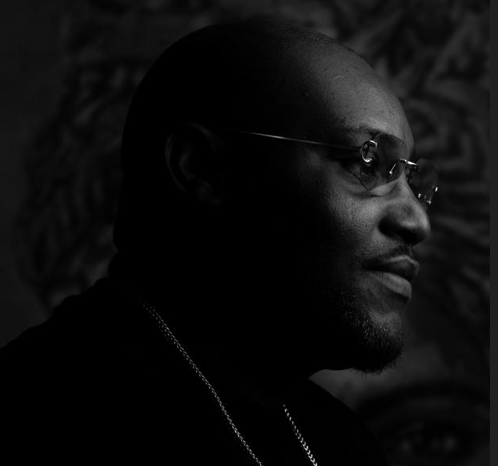
Marvic Chijioke Okeugo is a contemporary photographer and visual storyteller whose work engages culture, identity, and lived African experiences through a thoughtful visual lens. He has been an active member of the African Artists’ Foundation (AAF) since January 2022, aligning his creative practice with one of Africa’s most influential contemporary art institutions. The African Artists’ Foundation (AAF) is a leading non-profit organization dedicated to the promotion and development of contemporary African art. Founded by renowned curator Azu Nwagbogu, the foundation has played a significant role in shaping Africa’s visual culture through exhibitions, festivals, artist development programs, and international collaborations. AAF supports artists working across photography, fine art, multimedia, and curatorial practice, with a strong emphasis on artistic excellence, cultural relevance, and social engagement. Over the years, AAF has been associated with and has supported a network of highly respected African artists and photographers whose works have achieved both local and international recognition. These include George Osodi, an award-winning documentary photographer known for his powerful visual narratives on social and political issues; Andrew Esiebo, a globally recognized photojournalist whose work explores African identity, resilience, and everyday life; and Yagazie Emezi, a visual storyteller celebrated for her intimate documentation of culture, gender, and social justice themes. The foundation has also been linked with photographers such as Akintunde Akinleye, whose work focuses on documentary and lifestyle photography with strong cultural depth; Tam Fiofori, a veteran photojournalist widely regarded for his historical documentation of Nigeria’s political and cultural landscape; and Tunde Owolabi, a contemporary photographer and visual artist whose work blends storytelling with experimental approaches to African narratives. Collectively, these artists represent the depth, diversity, and global relevance of the AAF creative community. AAF operates on clear artistic criteria, supporting creatives whose work demonstrates originality, conceptual strength, consistency, and relevance to contemporary African realities. Photographers are particularly encouraged to use their practice as tools for documentation, storytelling, and cultural preservation. As a photographer, Marvic Chijioke Okeugo’s practice aligns closely with these values. Since joining the foundation in 2022, he has remained actively engaged within its creative ecosystem, contributing to and benefiting from a community committed to collaboration, professional growth, and artistic integrity. Marvic’s continued involvement with the African Artists’ Foundation places him among a respected network of African creatives working collectively to advance photography and visual storytelling as powerful instruments of representation, dialogue, and cultural memory.
The Grammar of Light: Understanding Deborah AbosedeIbeme’s Visual Language

Literally, when you stand in front of a Deborah Abosede Ibeme photograph long enough, you will notice something that shifts from the aesthetic experience it begins with, to a recognition of technical mastery, the quality of light that feels less like illumination and more like revelation, and then, the compositional weight that holds every element in a tension so precise it reads as inevitable. You register all of this in the first few seconds, the way you register the intelligence of a room before you have spoken to anyone in it. But then something else happens. The image begins to speak. Not loudly, and also not with the aggressive legibility of work that announces its own meaning, but in the patient, layered way that a conversation deepens after the pleasantries are done. You begin to notice what the fabric is saying, to understand what the subject’s stillness is holding. And then, ultimately, you begin to feel, with a specificity that is almost uncomfortable, that you are not looking at a photograph. You are reading one. This is what it means to encounter a visual language rather than a visual style. Every serious artist eventually develops a style. The rarest ones develop a language, something with its own grammar, its own rules of meaning, and it’s way of making the world legible. Style is the surface. Language is the structure beneath, the grammar of decisions that makes the surface say what it says. The African Womanhood Series, which Deborah began in 2021 as the conceptual anchor of her practice, is where the language first becomes legible. These are works that examine resilience, spirituality, and generational legacy among African women, but you risk missing what makes them remarkable if you focus on just describing them by their themes alone. The themes are the content. The language is how the content iscarried. And in works like “Veiled Majesty” and “Strength of The River Mother”, both produced within this foundational period and now available as limited-edition prints, the carrying is the achievement. The argument does not sit on top of the image. It is inside it, distributed across every decision she made before the shutter fired. Consider what she is doing with light in these earliest works. Most photographers think of light as a technical problem to be solved, a condition of the environment to be managed, corrected, made serviceable. Deborah treats it as a philosophical position to be taken. The light in her images is never ambient, never accidental, never simply the available illumination of a space. It is designed, constructed through studio lighting rigs she configures herself, reaching toward what she has described as a very specific quality: the weight before the ceremony. Warm. Dense. Full of what is about to happen. The kind of light that exists in the hour before something irreversible occurs, a rite, a birth, a crossing. In “Veiled Majesty”, this light falls on the subject with the deliberateness of a formal acknowledgment. It does not illuminate the woman so much as consecrate her, the shadows falling not to obscure but to define, to give the figure the kind of architectural presence that Dutch Golden Age portraiture gave to its subjects through precisely the same tonal logic. The reference is not decorative. In her earliest works, Deborah was already in conscious dialogue with Rembrandt and Vermeer, studying what those painters understood about the relationship between darkness and significance, and translating that understanding into a photographic practice applied to subject matter those painters never engaged with. Not imitation. Translation. The result is something that belongs to neither tradition entirely and to both simultaneously. Her shadows in her works are as carefully considered as her highlights. She works in deep tonal contrasts areas of rich, almost architectural darkness against which the subject emerges with a defined authority that is, in the context of images of African women, quietly radical. In a visual culture that has frequently photographed African women in conditions of flatness, even technically competent flatness, her light makes an assertion that her work is not a snapshot of a life, rather a formal acknowledgment of one. What the light does, the objects confirm. And if you walk slowly through any frame from this period and you will encounter things that do not belong to the category of props. Cowrie shells. Clay vessels. Traditional wrapper cloths tied in ways that carry specific regional meanings. Ritual implements drawn from Ijaw and Urhobo cosmological traditions. Fabrics, aso-oke, akwete, hand-dyed textiles, selected not for their visual beauty alone but for what they communicate to an eye that knows how to read them. In “Strength of The River Mother”, for instance, the relationship between the subject’s posture, the cloth she wears, and the objects surrounding her is not compositional arrangement. What you encounter is symbolic sentence construction. Each element is aword. The image is a statement. And the statement, about feminine power, the specific weight of the River Mother figure in Ijaw cosmology, about the relationship between endurance and divinity in Niger Delta spiritual tradition requires all three elements to be accurate, not merely beautiful, in order to hold its meaning. This is the distinction that separates Deborah’s use of symbolic material from the decorative Africanist aesthetic that photography has frequently produced. That’s when we say she speaks symbols instead of borrowing them. And in the earliest works of the African Womanhood Series, she was already speaking them with a fluency that suggested years of study not just months. The cowrie shell is instructive here. In the visual grammar of the Niger Delta, the cowrie is not a decorative element but a marker of value, of spiritual protection, and of feminine power. It’s a currency older than paper and a symbol older than many of the languages that might try to describe it. When it appears in her works, it is not there because it looks interesting against dark skin. No. It is there because it means something specific, and she knows
“Where Ancestors Still Breathe”Deborah Abosede Ibeme’s Debut Solo at the Nike ArtGallery Is the Most Assured First Exhibition Lagos HasSeen in Years
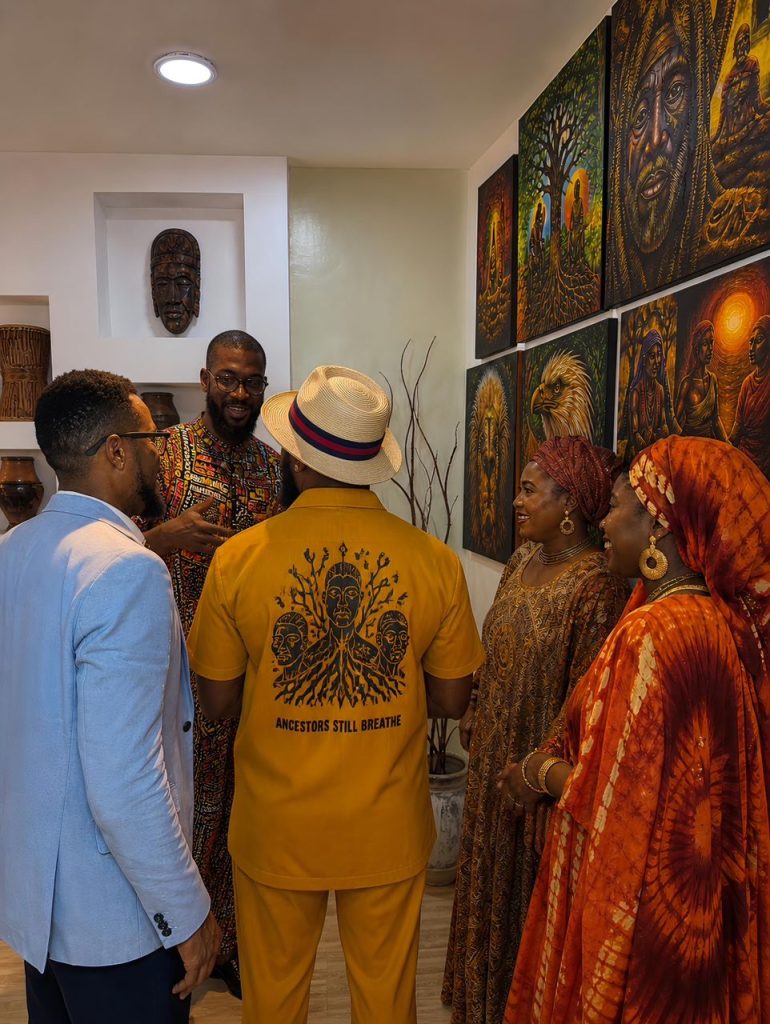
On a Tuesday evening in March, the Nike Art Gallery on Lekki Expressway fills with theparticular energy of an opening night that feels like more than an opening night. Thecrowd is the usual Lagos art crowd, collectors, creatives, critics, the culturally curious. But there is something in the quality of attention in the room that is different from theusual. With the usual opening nights where people circulate, loosely organised socialperformance around the presence of art on walls. With this exhibition, the atmospherewas one such that the crowd were standing in front of the photographs, speaking in thelowered voices that people use when they are not entirely sure what they are feeling butare certain they are feeling something. The exhibition titled “Where Ancestors Still Breathe”, a solo show with eight large-formatfine art photographs, each one mounted with the kind of care and spatial considerationthat tells you the person who made them understands that how a work is presented ispart of what the work is saying. The photographer, Deborah Abosede Ibeme is a Warri,based fine artist. She has been working professionally as a fine art photographer for twoyears.Two years.It is worth pausing on that before moving any further. A little note on The Nike Art Gallery shows that the gallery is reputable for showing worknot just because an artist is promising but because the work is ready. This is one ofNigeria’s most significant cultural institutions, a space with a permanent collection ofover eight thousand works, a history of exhibiting artists whose practices have shapedNigerian fine art across generations, and an audience whose sophistication has beenbuilt through years of sustained engagement with the best available. When aphotographer mounts a solo here, the implicit argument of the institution is that the workbelongs in this space, not as a developmental gesture or an early-career investment,but as a statement of current achievement. “Where Ancestors Still Breathe” belongs inthis space. Completely, without qualification, on its own terms. The exhibition occupies the gallery with a quality that is immediately present before anyindividual work has been closely examined. The light inside the photographs, and itwould be more accurate to call it the light Deborah builds inside the photographs, (sincenothing about it is accidental,) establishes a temperature for the whole space. Warm.Dense. Carrying the specific weight of a moment just before the ceremony. It is the kindof light that makes a room feel held rather than simply illuminated, and it draws visitorstoward the works with the mild, insistent pull of something that wants to be stood in frontof. The subject of the exhibition is announced in the title and explored in the works with aphilosophical seriousness that curatorial language rarely achieves. “Where AncestorsStill Breathe” takes its name and its central argument from the cosmological tradition ofthe Niger Delta, specifically the Ijaw and Urhobo understanding that the ancestors arenot historical figures but active presences. “Not behind us in time, but beside us inspace,” as Deborah herself would assert. Breathing through the choices we make, thebodies we inhabit, the practices we maintain or allow to slip quietly out of the livingworld. This is not metaphor in the tradition Deborah is working within. It is ontology, aspecific and seriously held account of how reality is structured, of who is in the roomand what their relationship to the living is. The photographs do not illustrate this belief. They embody it. They are built, and builtmost definitely fits this context because this images do have the quality of beingconstructed, and it is so, to make the ancestral presence tangible. To give it a visualform that a viewer can stand in front of and feel, in the body, before the mind has hadthe chance to organise what is being experienced into something more manageable.Move into the works themselves and the first thing that demands attention is the use ofsymbolic objects. These are not props. That word is inadequate and inaccurate for whatDeborah is doing with the material she places in her frames. Cowrie shells appear inseveral of the works, arranged with a precision that is communicative rather thandecorative. In the visual grammar of the Niger Delta, the cowrie carries specificmeaning: value, spiritual protection, feminine power, a cultural currency. When theyappear in these images, they are doing the work of vocabulary. They make a statementabout the woman in the frame, about what she carries and what she is worth, in alanguage that the image does not need to translate because the image was built in thatlanguage from the beginning. Wrapper cloths appear across the exhibition tied with a specificity that communicates tothose who know how to read it, the knot, the arrangement, the choice of fabric itselfcarrying information about identity, status, ceremonial context. Clay vessels. Ritualimplements drawn from Urhobo and Ijaw tradition. Each object placed with the care ofsomeone who has spent serious time understanding what the object means beforedeciding whether it belongs in the frame. This level of symbolic accuracy is one of the most intellectually significant qualities ofthe exhibition and one of the most difficult to achieve. Photography has a long history ofusing African cultural material, fabrics, objects, adornment as visual texture, as thesignifiers of a generalised cultural identity that adds atmosphere to an image withoutadding meaning. “Where Ancestors Still Breathe” does not do this. The objects in theseframes are specific, accurately deployed, and integral to the meaning of the images theyappear in. Remove them and the images lose something they cannot afford to lose.This is the difference between a photographer who has researched a culture and aphotographer who is working from inside one. The subjects of the photographs are mostly women. This is not incidental.The African Womanhood Series, the body of work from which these exhibition piecesare drawn is built on the understanding that the African woman is not simply aparticipant in cultural tradition but its primary custodian. She is the one who knowswhich fabric belongs to which ceremony, which object must be handled with which care,which gesture communicates what to whom in which context. She is, in Deborah’sframing, the living archive, the
Where Ancestors Still Breathe” Leaves Lasting Impression on Lagos Art Scene
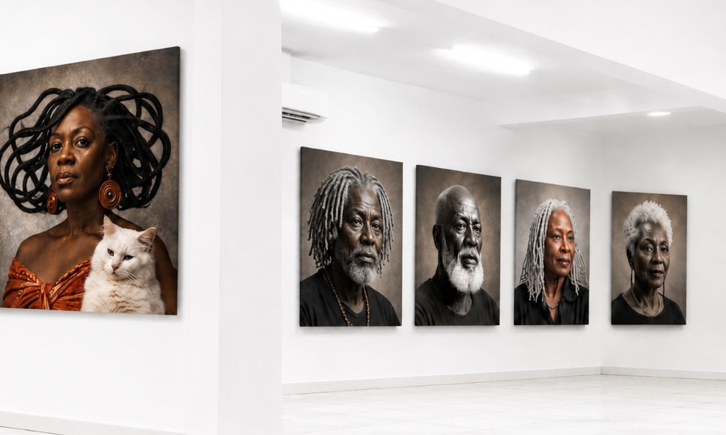
The recently concluded solo exhibition “Where Ancestors Still Breathe” by acclaimed fine art photographer Deborah Abosede Ibeme delivered an unforgettable artistic experience, drawing art lovers, collectors, creatives, and cultural enthusiasts to the prestigious Nike Art Gallery in Lekki, Lagos. Held from March 15th to March 19th, 2022, the five-day exhibition captivated visitors with a powerful collection of fine art photography that explored African identity, ancestry, spirituality, and cultural memory through deeply emotive visual storytelling. From the opening day, guests were immersed in a carefully curated body of work that combined striking portraiture, traditional African symbolism, textured styling, and intimate narratives that resonated strongly with audiences. Many attendees described the exhibition as both emotionally moving and visually breathtaking, praising Deborah’s ability to preserve culture while presenting it through a contemporary artistic lens. The exhibition attracted a diverse audience including fellow artists, photographers, collectors, students, media personalities, and members of the Lagos creative community, all eager to experience the conversations embedded within each frame. Speaking after the successful showcase, Deborah Abosede Ibeme expressed gratitude for the overwhelming support and meaningful connections formed throughout the exhibition. “This project came from a deeply personal place, and seeing people connect emotionally with the work was incredibly fulfilling. It reminded me that art has the power to awaken memory, identity, and shared humanity,” she said. One of the defining highlights of “Where Ancestors Still Breathe” was its ability to spark dialogue around heritage, self-discovery, and the importance of preserving African stories through visual art. Visitors spent time engaging thoughtfully with the pieces, many reflecting on how the photographs evoked familiarity, nostalgia, and pride in African identity. Hosted at the renowned Nike Art Gallery, the exhibition further reinforced the growing influence of African fine art photography within both local and international art conversations. Deborah’s work stood out not only for its technical excellence, but for its emotional depth and cultural authenticity. As the exhibition comes to a close, “Where Ancestors Still Breathe” leaves behind more than memorable images it leaves a lasting cultural imprint and establishes Deborah Abosede Ibeme as a compelling voice in contemporary African fine art photography. The success of the exhibition signals a promising future for the artist, whose work continues to challenge perspectives while honoring the beauty, strength, and spirit of African heritage.
Fine Art Photographer Deborah Abosede Ibeme Announces Solo Exhibition “Where Ancestors Still Breathe” in Lagos
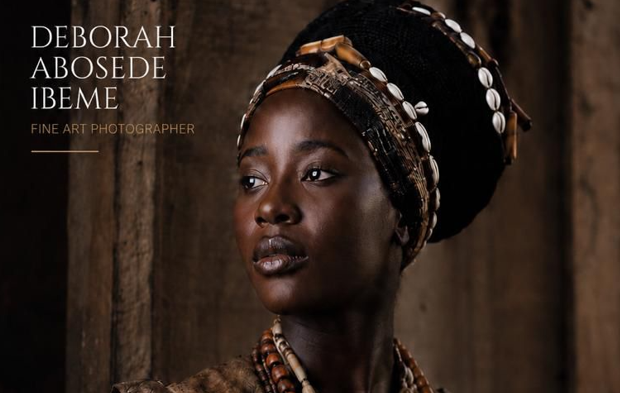
Art lovers, collectors, cultural enthusiasts, and photography admirers are set to experience an evocative journey through memory, identity, and African heritage as fine art photographer Deborah Abosede Ibeme unveils her highly anticipated solo exhibition titled “Where Ancestors Still Breathe.” Scheduled to run from March 15th to March 19th, 2022, the exhibition will be held at the prestigious Nike Art Gallery, Lekki Phase 1, Lagos, and will open daily from 10AM to 6PM. Known for her deeply expressive visual storytelling, Deborah Abosede Ibeme has built a reputation for creating portraits that transcend aesthetics and speak directly to the soul. Through carefully composed imagery, rich textures, and culturally rooted symbolism, her work explores themes of ancestry, spirituality, womanhood, resilience, and the enduring connection between the past and the present. “Where Ancestors Still Breathe” is expected to offer viewers more than an art exhibition it promises an immersive emotional experience. Each photograph serves as a visual conversation between generations, inviting audiences to reflect on identity, memory, and the silent echoes of those who came before us. Speaking ahead of the exhibition, Deborah described the project as a personal and spiritual exploration of African roots and inherited stories. “This body of work is a reminder that our ancestors are never truly gone. They live in our traditions, our faces, our voices, and the spaces we carry within us,” she shared. Hosted at Nike Art Gallery one of Nigeria’s most respected cultural institutions the exhibition is expected to attract artists, curators, collectors, students, and members of the creative community from across the country. The exhibition also highlights the growing global recognition of African fine art photography and its power to preserve culture while challenging contemporary narratives. Guests attending “Where Ancestors Still Breathe” can expect a carefully curated showcase of striking photographic pieces that blend traditional African aesthetics with modern fine art expression.
Bloodline in Bold Print: A Solo Exhibition by Goodluck Jane in Kampala, Uganda

Afriart Gallery is pleased to present Bloodline in Bold Print, a solo exhibition by Nigerian multidisciplinary visual artist Goodluck Jane, opening at Afriart Gallery, Kampala, from October 1 to October 7, 2021. The exhibition brings together a compelling body of work that explores ancestry, inheritance, and identity as evolving processes shaped by memory, material, and cultural transmission. Rooted in an intimate engagement with African textiles particularly Ankara Bloodline in Bold Print positions fabric as both subject and medium. Rather than serving as decorative surface, textile functions as a living archive: a carrier of memory, a witness to lived experience, and a conduit through which stories of lineage are preserved, altered, and reimagined. Through this material language, Jane reflects on how everyday objects hold complex narratives of belonging, origin, and continuity. The exhibition considers bloodline not solely as a biological inheritance, but as a layered framework through which identity is formed. Jane examines emotional memory, cultural practices, social expectations, and unspoken histories as forms of inheritance that quietly shape individuals and communities. These invisible transmissions often overlooked in daily life are brought into focus through works that invite viewers to reflect on the legacies they carry, consciously or otherwise. African textiles occupy a central role within Jane’s visual language as markers of cultural belonging and collective memory. Their familiarity draws viewers in, while their symbolic weight encourages deeper engagement. Within many African contexts, textiles communicate history, status, emotion, and ritual. By foregrounding these materials, Jane highlights their role as tools through which culture is expressed, negotiated, and sustained. With Bloodline in Bold Print, Afriart Gallery continues its commitment to supporting contemporary African artists whose practices critically engage with history, material culture, and lived experience. The exhibition underscores the gallery’s dedication to fostering conceptually grounded artistic practices that expand contemporary discourse. Through Goodluck Jane’s visually striking and thoughtful body of work, Bloodline in Bold Print offers audiences an opportunity for sustained reflection on lineage, memory, and self-definition reminding us that identity is not only inherited, but continually shaped through lived experience.
Bloodline in Bold Print: A Solo Exhibition by Goodluck Jane in Kampala, Uganda
Afriart Gallery is pleased to present Bloodline in Bold Print, a solo exhibition by Nigerian multidisciplinary visual artist Goodluck Jane, opening at Afriart Gallery, Kampala, from October 1 to October 7, 2021. The exhibition brings together a compelling body of work that explores ancestry, inheritance, and identity as evolving processes shaped by memory, material, and cultural transmission. Rooted in an intimate engagement with African textiles particularly Ankara Bloodline in Bold Print positions fabric as both subject and medium. Rather than serving as decorative surface, textile functions as a living archive: a carrier of memory, a witness to lived experience, and a conduit through which stories of lineage are preserved, altered, and reimagined. Through this material language, Jane reflects on how everyday objects hold complex narratives of belonging, origin, and continuity. The exhibition considers bloodline not solely as a biological inheritance, but as a layered framework through which identity is formed. Jane examines emotional memory, cultural practices, social expectations, and unspoken histories as forms of inheritance that quietly shape individuals and communities. These invisible transmissions often overlooked in daily life are brought into focus through works that invite viewers to reflect on the legacies they carry, consciously or otherwise. African textiles occupy a central role within Jane’s visual language as markers of cultural belonging and collective memory. Their familiarity draws viewers in, while their symbolic weight encourages deeper engagement. Within many African contexts, textiles communicate history, status, emotion, and ritual. By foregrounding these materials, Jane highlights their role as tools through which culture is expressed, negotiated, and sustained. With Bloodline in Bold Print, Afriart Gallery continues its commitment to supporting contemporary African artists whose practices critically engage with history, material culture, and lived experience. The exhibition underscores the gallery’s dedication to fostering conceptually grounded artistic practices that expand contemporary discourse. Through Goodluck Jane’s visually striking and thoughtful body of work, Bloodline in Bold Print offers audiences an opportunity for sustained reflection on lineage, memory, and self-definition reminding us that identity is not only inherited, but continually shaped through lived experience.
Bodies in Blue: An Ankara Study — A Solo Exhibition by Goodluck Jane
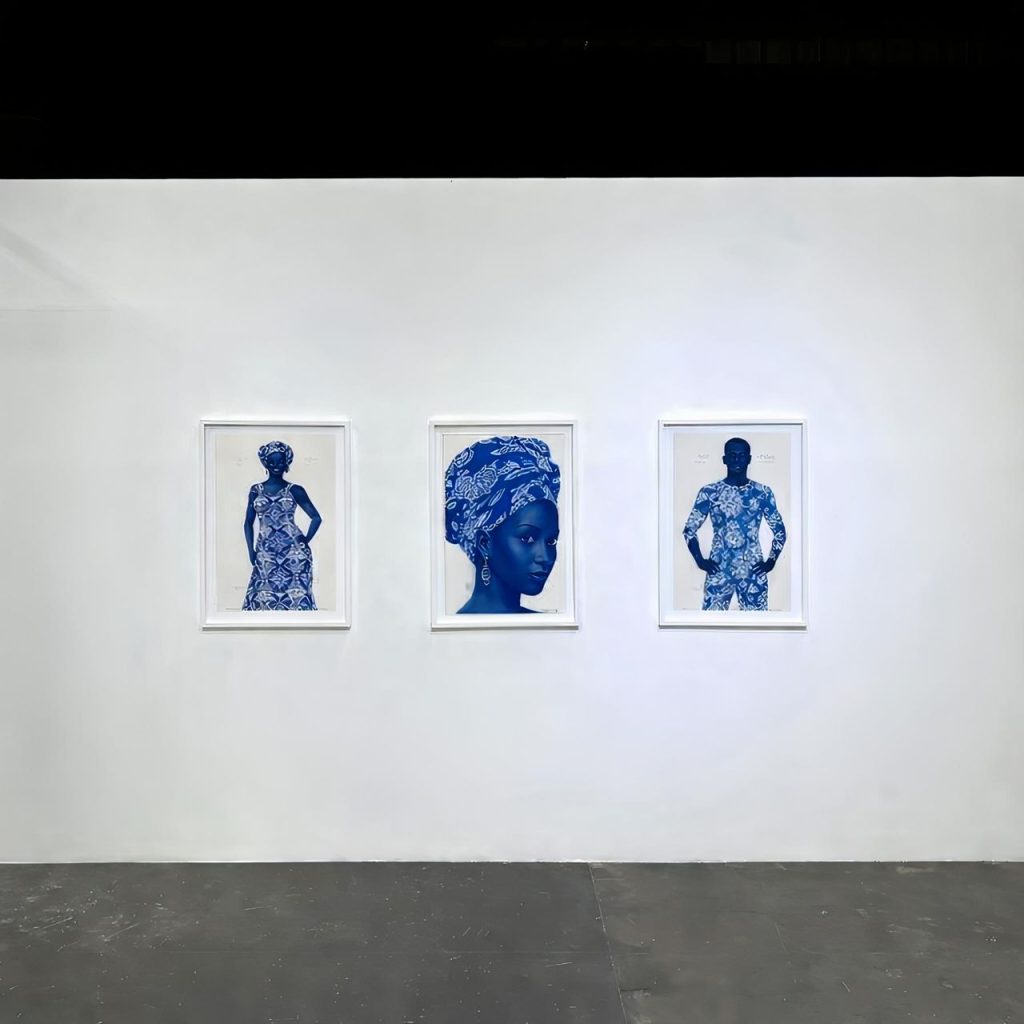
An Ankara Study, a compelling solo exhibition by Nigerian mix media visual artist Goodluck Jane, on view from June 19 to 21, 2021, Dubai, UAE Zawyeh Gallery. The exhibition invites audiences into an immersive exploration of the human body, memory, and cultural heritage through the language of Ankara fabric, positioning textile as both material and metaphor within contemporary African art. In Bodies in Blue, Jane transforms the gallery into a resonant field of texture, pattern, and color. Through meticulous layering, precise motif placement, and a richly modulated blue palette, the artist constructs compositions that oscillate between intimacy and monumentality. Ankara traditionally associated with adornment and everyday life emerges here as a site of narrative depth, carrying histories of identity, emotion, and collective memory. At the heart of the exhibition is the human form, rendered not as a static subject but as a conduit between the personal and the communal. Jane’s figures unfold through folds of fabric, their gestures and silhouettes shaped by repetition, rhythm, and variation. Visitors are invited to “read” the textile surfaces as they would a story tracing patterns that speak of resilience, continuity, and lived experience. The works encourage close looking, rewarding attention with subtle shifts in tone, alignment, and meaning. Blue anchors the exhibition’s emotional and conceptual register. Moving from soft indigo to deep, contemplative navy, Jane’s chromatic range evokes calm, melancholy, and introspection, guiding the eye and shaping the viewer’s movement through the space. The strategic use of repetition and layering establishes a visual cadence, underscoring the artist’s mastery of both technique and narrative construction. Zawyeh Gallery’s thoughtful curation amplifies the exhibition’s impact. Carefully calibrated lighting reveals the tactile nuances of the fabric, while spatial sequencing allows each work to breathe inviting both intimate engagement and an appreciation of scale. The gallery becomes an active participant in the experience, framing the artworks as a cohesive environment rather than isolated objects. Bodies in Blue: An Ankara Study also speaks to broader conversations around contemporary African textiles and their evolving place within global art discourse. By reimagining Ankara as a medium of intellectual and emotional inquiry, Jane challenges conventional hierarchies of material and elevates textile to a powerful vehicle for storytelling. The exhibition foregrounds craftsmanship and process, making visible the labor, precision, and intentionality embedded in each composition. Presented in Dubai’s dynamic, international art landscape, the exhibition creates space for cross-cultural dialogue connecting local and global audiences through shared themes of identity, memory, and the body’s relationship to society. Collectors, curators, artists, and students alike are invited to engage with a practice that bridges heritage and contemporary expression with clarity and depth. With Bodies in Blue: An Ankara Study, Goodluck Jane affirms her position as a vital voice in textile-based contemporary art. Zawyeh Gallery is proud to present this timely exhibition, anticipating the conversations it will spark and the lasting impressions it will leave on audiences encountering the transformative power of fabric reimagined.
Bodies in Blue: An Ankara Study by Goodluck Jane

Dubai, UAE – Zawyeh Gallery is set to host Bodies in Blue: An Ankara Study, a major solo exhibition by Nigerian multidisciplinary visual artist Goodluck Jane, on view from June 19–21, 2021. Known for her innovative fusion of painting, textile manipulation, and mixed media, Jane presents an immersive body of work that explores the human body as a site of memory, identity, and cultural continuity. Bodies in Blue marks a significant moment in Jane’s practice, bringing together years of investigation into materiality, corporeality, and narrative. Using Ankara fabric as both medium and metaphor, the artist transforms textile into an expressive language one that records gesture, emotion, and lived experience. The body in Jane’s work is not merely represented; it becomes a vessel that carries personal histories and collective memory. Central to the exhibition is Jane’s nuanced exploration of the color blue. Moving from delicate, atmospheric tones to deep, contemplative indigos, her palette evokes calm, introspection, melancholy, and endurance. These layered blues frame the human figure and create a visual rhythm that connects individual presence to broader cultural experience. Through repetition, pattern, and silhouette, Ankara is reimagined not as decoration but as a powerful tool of storytelling and remembrance. The exhibition design at Zawyeh Gallery has been carefully conceived to encourage both close observation and spatial immersion. Visitors are invited to engage with the intricate textures of fabric, the layering of motifs, and the interplay between positive and negative space, while also experiencing the architectural scale and compositional flow of the installations. Light, movement, and circulation work together to heighten the sensory and conceptual impact of the work. Beyond its visual richness, Bodies in Blue interrogates the social and cultural meanings embedded in everyday materials. Jane’s practice challenges conventional perceptions of African textiles, demonstrating how Ankara can function as archive, narrative, and intellectual inquiry. Each work reflects on identity, resilience, and the layered histories woven into fabric, where personal, familial, and collective stories intersect. Dubai’s cosmopolitan context provides a compelling platform for the exhibition, inviting collectors, curators, artists, students, and the wider public to engage with contemporary African textile-based practice within a global discourse. The exhibition encourages cross-cultural dialogue and positions African material traditions firmly within contemporary art conversations. Bodies in Blue: An Ankara Study is ultimately an invitation to reconsider the relationship between fabric, body, and memory. Through meticulous craftsmanship and conceptual depth, Goodluck Jane elevates textile into a living, expressive medium one capable of conveying emotion, history, and presence. The exhibition offers a reflective and immersive experience that underscores Jane’s position as a compelling voice in contemporary visual art.
Ųmų Anya (Children of the Eye): A Solo Exhibition by Mavic Chijioke Okeugo

Lagos, Nigeria Rele Gallery presents Ųmų Anya (Children of the Eye), a solo exhibition by fine art photographer Mavic Chijioke Okeugo, on view from April 6–12, 2021. The exhibition introduces a new body of work that meditates on childhood, perception, and the profound act of seeing through youthful eyes. Translated from Igbo, Ųmų Anya Children of the Eye encapsulates the exhibition’s central concerns with vision, awareness, and emotional insight. Okeugo positions children as both subjects and storytellers, crafting images that exist in the liminal space between reality and imagination. Meticulously composed and richly textured, the photographs carry a painterly sensibility that invites sustained looking and quiet reflection. Across scenes of play, movement, and stillness, the works consider how children interpret the world and how memory preserves these early modes of perception. Eschewing sentimentality, Okeugo presents childhood as a site of strength, curiosity, and calm authority encouraging viewers to reassess their own perspectives and reconnect with the discipline of attentive seeing. Installed within Rele Gallery’s minimalist setting, Ųmų Anya (Children of the Eye) unfolds as an immersive visual experience where color, form, and narrative converge with clarity and intent. The exhibition marks a significant moment in Okeugo’s artistic trajectory and contributes meaningfully to contemporary conversations in African fine art photography. The exhibition is open to the public April 6–12, 2021, at Rele Gallery, Lagos. Exhibition DetailsArtist: Mavic Chijioke OkeugoTitle: Ųmų Anya (Children of the Eye)Dates: April 6–12, 2021Venue: Rele Gallery, Lagos