
Think pink if you’re feeling blue. Fashion’s return to bold colour delivers a welcome dopamine hit, offering a momentary escape during uncertain times.
Canary yellow and lime green at Prada. Electric blue and citrus orange at Loewe. Fuchsia and bright red at Alaïa. All signal the return of colour on runways and, increasingly, in our wardrobes.
After what felt like an eternity dominated by quiet luxury and subdued palettes, bright hues arrive as a vibrant antidote. The shift feels almost emotional. As designer Oscar de la Renta once said, “I like light, colour, luminosity. I like things full of colour and vibrant.” The sentiment rings true not only in fashion but in life itself.
When everything around us feels precarious, colour cuts through the noise with immediacy and joy. It arrives at a time marked by global unrest, when restraint often feels like the default response. Choosing colour in uncertain moments is not an act of denial but of resilience, a way of carrying beauty forward even when the world feels heavy.
Bright hues become both escape and assertion: a refusal to mirror the bleakness of the moment and a deliberate embrace of optimism.
Fashion has leaned into bold expression before, often during periods of social rupture. The 1960s Flower Power movement emerged from anti-war demonstrations and a countercultural rejection of rigid post-war norms. Clothing became the visual language of freedom, with psychedelic prints and acid-bright colours defining the era. The aesthetic symbolised a generation questioning authority and searching for alternative ways of living.
High fashion absorbed that energy too. One enduring image is Audrey Hepburn in a mint-green suit by Givenchy in the 1964 film Paris When It Sizzles, a moment that illustrates how the era’s vivid palette moved from the streets and protests into luxury design.
The 1980s offered a similar shift. As more women entered the workforce and economic independence expanded, fashion embraced exaggerated silhouettes and saturated colour. Jane Fonda became an emblem of the era’s “fit girl” culture, her neon leotards and leg warmers turning athletic wear into a cultural statement.
On television, Joan Collins embodied high-impact glamour in the series Dynasty, where power dressing and bold colour became visual shorthand for ambition and confidence.
Today, as the world navigates its own sense of instability, geopolitical conflict, economic uncertainty and cultural fatigue, fashion once again turns to colour as a form of emotional release.
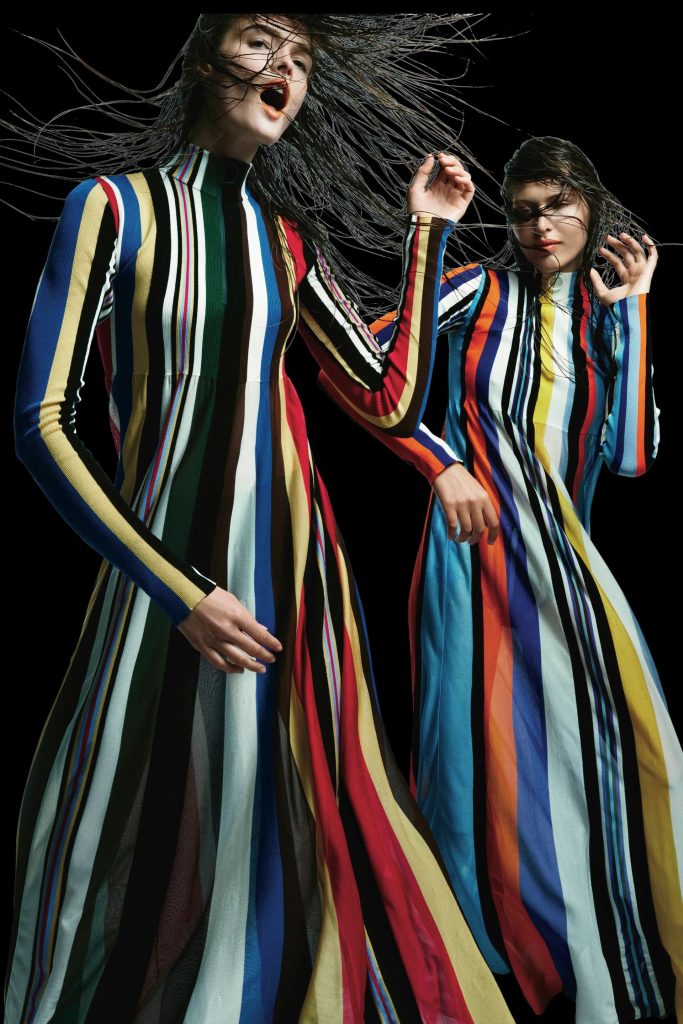
At Prada, a citron-yellow jacket appears layered over a shirt and paired with a black taffeta bubble-hem skirt. Loewe sends a floor-length dress down the runway punctuated with electric stripes and finished with a scuba-inspired zip.
When colour returns, it often feels instinctive. After long periods of restraint, the body seems to crave brightness before the eye even notices it.
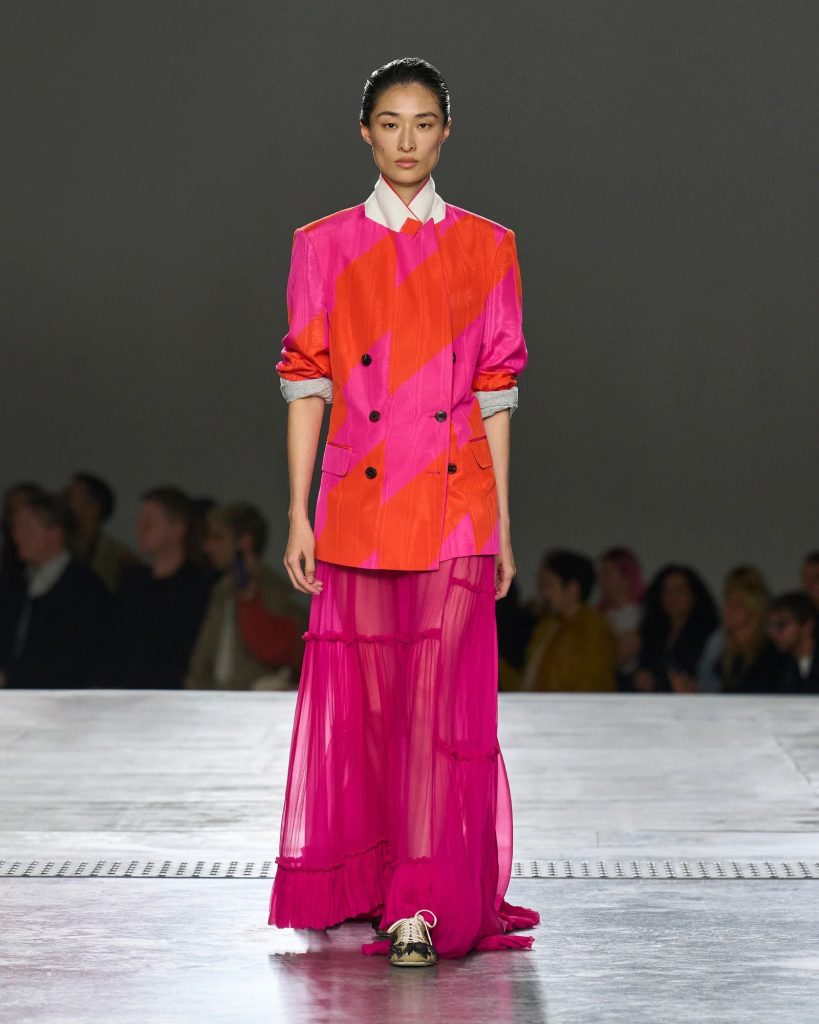
At Chanel, creative director Matthieu Blazy delivered a striking flamenco-inspired red skirt that radiated movement and joy. Meanwhile, Julian Klausner at Dries Van Noten presented a two-tone orange-and-pink tailored blazer layered over a diaphanous fuchsia skirt, an unapologetic celebration of saturation.
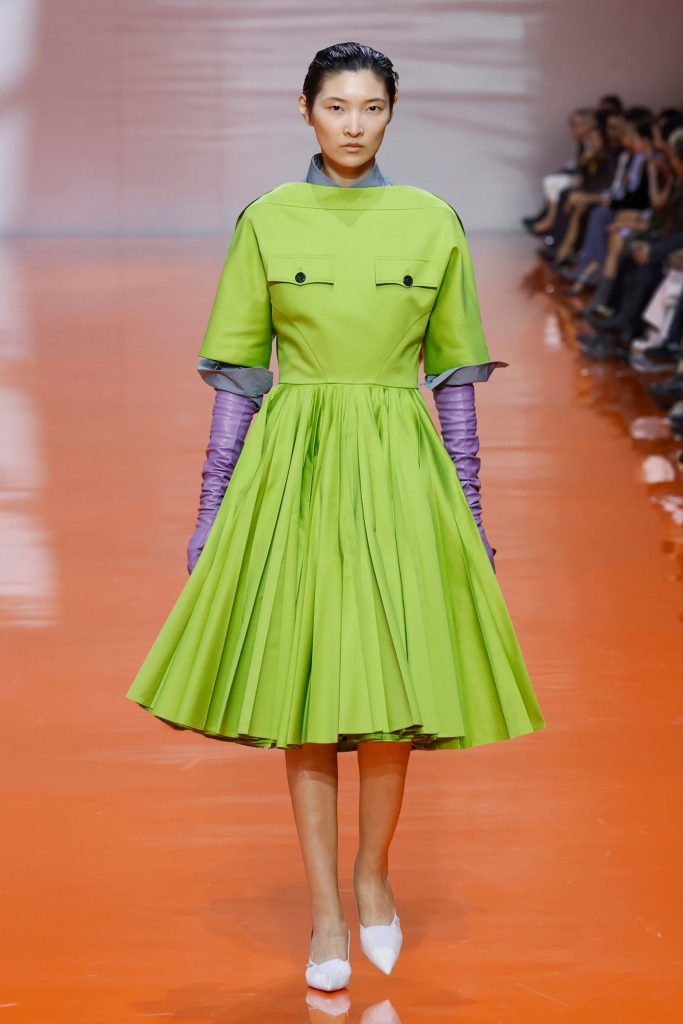
Regionally, the same sentiment appears across emerging labels. The Emirati brand Onori embraces colour as an emotional language: a bright orange sequinned mini dress, a deep purple shirt tucked into a sunshine-yellow skirt, or a lime-green pleated gown paired with a blush-pink cape. Here, colour is not decorative, it is expressive, emerging when silence becomes too heavy to carry.
On screen, the same impulse plays out, with television acting as a barometer of fashion’s mood. In the series All’s Fair, Kim Kardashian appears in a billowing bright-yellow dress by Valentino, baseball bat in hand, a moment where colour feels almost confrontational.
Meanwhile, Emily in Paris continues to revel in saturated palettes. Lily Collins wears a green embroidered jacket with matching shorts before switching to a vivid orange blazer by Marc Jacobs. Neither show challenges viewers intellectually, but both succeed in transporting audiences to worlds where colour heightens emotion and fantasy takes precedence over realism.
The way we dress often reflects how we feel or how we want to feel. When everything around us appears grim, fashion has the power to lift us beyond the moment. Not as an act of defiance, but as a collective affirmation that hope still has a place.
Vivid clothing allows us to express optimism, softness and strength all at once, a reminder that joy can still exist, and be worn.
Few things shift the mood as instantly as slipping into a bright red dress that says, simply: I’m here.