


Joy Fache James is that kind of maker that resists the invitation to romanticise what they do. When you ask her about the craft behind Paciencia her brand, she always does not reach for the elevated language, then the odes to heritage, the reverence for tradition, that the accessories industry has learned to deploy as a substitute for genuine craft knowledge. She speaks about leather the way someone speaks about something they have spent years learning to understand. Precisely. Without decoration. With the specific authority of a person who has made enough things incorrectly to know exactly what correct feels like.
We spoke in March, in the middle of a production run. She had been in the studio all morning.
La Mode: Walk me through the beginning. When a new piece starts, where does it actually start for you?
Fache:
Apparently with the leather. Always with the leather.
Before I have made any design decision for a new piece, I am handling the material. Feeling the weight of it. The suppleness. The specific response under pressure, how it gives, how it recovers, how it holds its shape when you fold it and release it. You can feel all of these with your hands, once you know what you are doing. And the particular feeling that the leather communicates determines what design decisions are available to me.
There is leather that will take the weaving I want to do and there is leather that will not, one that will stress at the interlace points, or that will not hold the tension the technique requires. There is leather that will accept a specific edge treatment and leather that will fight it. Understanding this before I cut a single piece is not optional. It is upon this foundation that everything else follows.
So I assess every hide. Anything that does not give me what the design requires does not move forward. It sounds simple though, but that’s an enormous amount of the work.
La Mode: And you source in Nigeria. That is a specific commitment. What does Nigerian leather give you that you could not get elsewhere?
Fache:
It gives me knowledge of the material that I could not have if I were sourcing from somewhere I could not visit and handle and build a relationship with.
I know the leather I work with because I’ve spent the last three years working with it.
I know which finishes it responds to best. I know how pebbled grain behaves under weaving compared to croc emboss. I know what crushed leather demands from me when it comes to edge treatment. These aren’t things I learned from a manual or a supplier’s catalogue. They’re things I figured out through years of handling the material, making mistakes, adjusting, and working with it over and over again.
That knowledge wasn’t handed to me. I built it through experience with this specific material, in this specific environment.
If I switched to sourcing from a European tannery tomorrow, I would be working with an entirely different material. I would have to start building that understanding again from the ground up. And beyond that, I would lose something else I’ve come to value: my relationship with the local production chain. I know what this leather is, where it comes from, and the people and processes that shape it before it ever reaches my workshop.
That familiarity is part of the knowledge too.
That relationship is not sentimental. It is practical. It makes me a better maker.

La Mode: Tell me about the cutting. The Paciencia silhouettes seem to be very clean, minimal, architectural. Does that make the cutting easier or harder?
Fache:
Much harder.
You know that when a design is busy, there are more places for small imperfections to disappear. For instance, a seam that’s slightly off can get lost in the details; or an edge that’s not perfect would likely be less noticeable when there are embellishments competing for attention.
With a minimal design, everything is exposed. Every line matters, every proportion.
There’s nowhere to hide.
So when I’m cutting, I’m not just looking at a flat piece of leather. I’m thinking about the finished bag and how it will actually be used, how it will sit when it’s full, and even how it will behave after months of being carried. I also consider how it will respond to heat, rain, weight, and movement. Something that looks perfect on a worktable can behave very differently once it becomes a real object in someone’s life.
A lot of that understanding only comes with experience. After you’ve made enough pieces, you start developing an instinct for how the leather will move, stretch, settle, and hold its shape. I’m still learning that. Every project teaches me something new.
LA Mode: The weaving. This is the thing that is most specifically Paciencia. Take me inside that process.
Fache:
The weaving is much slower than most people think.
Even when people know it’s handmade, they usually underestimate how much time and attention it actually takes.
Picture this, you’re placing individual strips of leather one at a time, and every strip has to sit at the right tension. Too loose and the weave loses structure. Too tight and you’re putting unnecessary stress on the leather.
The interesting thing is that there isn’t a formula for finding that balance. It’s something you feel. The knowledge develops in your hands before you can even explain it in words.
And the tension isn’t constant across the entire panel. As the weave grows, the leather responds differently. What felt right ten minutes ago might need a slight adjustment now because of what’s happening around it. So you’re making decisions continuously throughout the process.
What I love about hand-weaving is that it creates a kind of consistency that machines can’t quite replicate. I’m not saying it’s better in every way, no. But it’s human, and that makes all the difference.
No two pieces are ever exactly alike. They can be consistent in quality, in structure, in appearance, but they’re not identical. Each one carries small traces of the person who made it. To me, that’s part of the beauty too.
La Mode: What about the interior, the leather lining mean. People don’t see this. Why does it matter?
Fache:
Because it doesn’t matter who sees anything about the bags I make, so long as they serve the owner for the purpose for which they were bought. And the linings? They’re a part of the bags the owners get to experience every day.
The inside of a bag is probably the most personal part of it. It’s the surface your hands touch constantly. It’s where you interact with the object most often.
A lot of brands use fabric linings because they’re less expensive and faster to work with, and most people never see them anyway.
I chose leather because it felt right for the kind of product I wanted to make. The bag is built from leather, so I believe the interior should reflect that too. It ages well, it holds up to years of use, and it creates a different experience every time someone reaches into the bag.
For me, it’s also about standards. It’s easy to maintain quality in the places everyone can see. The real test is whether you’re willing to maintain that same standard in the places they can’t.
That’s what matters to me.
LA Mode: The finishing stage. You have said you have a conversation with each piece at the end. What does that mean?
Fache:
It means I spend time with it before I let it go.
Once the construction is complete and everything is assembled, I pick the piece up and go through it carefully to see if there’s anything that still feels unresolved.
It could be an edge that could benefit from being cleaner. Maybe it’s a section of weaving that needs a little more attention, or a detail that nobody else would ever notice.
Most customers probably wouldn’t see those things. But I would.
And if I can see them before the piece leaves my hands, then I feel responsible for fixing them.
Details are all there is to quality and exceptional bag-making. I’ve learned that the overall experience of a product is shaped by these small details. A customer may never identify the exact reason something feels exceptional or disappointing, but those details accumulate over time and ultimately define how the product is perceived.
So I keep working until I feel confident there’s nothing left to improve. And honestly, that’s my favourite part of the entire process. That moment or self satisfaction from what you’ve deliberately made yourself to the standard you want it to be and that it is meant to be.
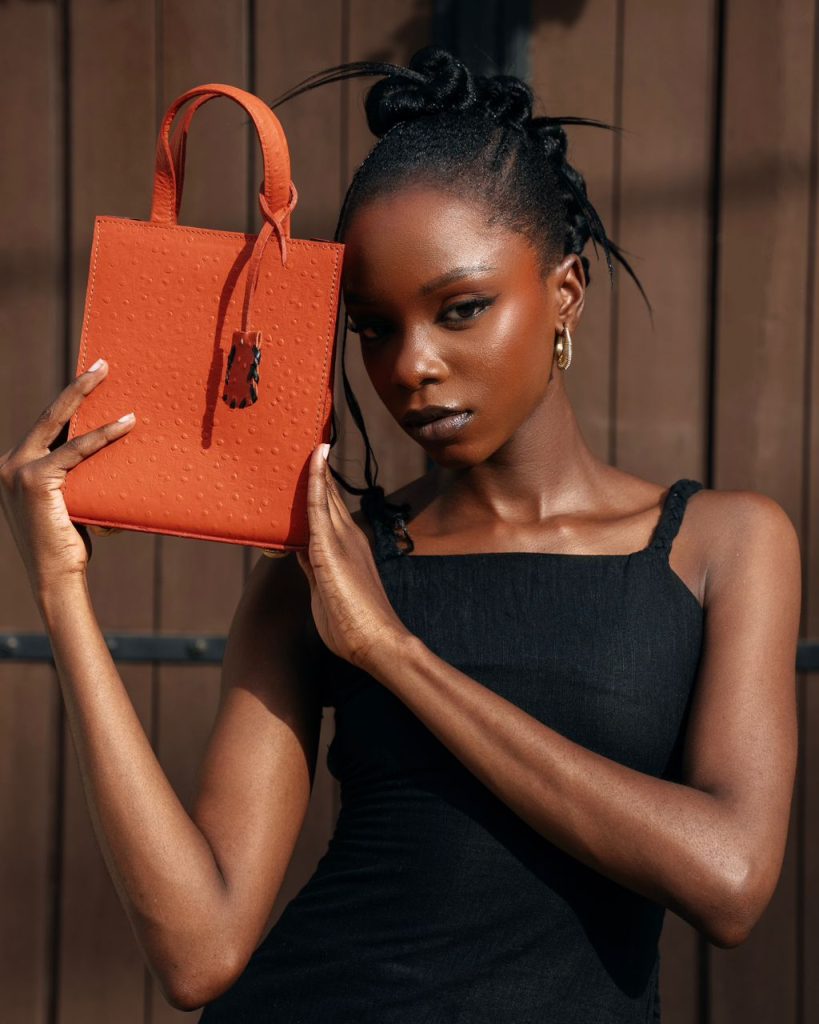
La Mode: I resonate with that moment too, and I believe it’s so for every creative as well. Last question. Three years of making this. What has the leather taught you that you did not expect to learn?
Fache:
You already know the answer. Patience, actually.
When I started, I thought good craftsmanship was mostly about imposing your standards on the material, you know, like having a vision and executing it.
What I’ve learned is that materials have their own character.
Leather responds the way leather responds. The grain behaves the way the grain behaves. You can understand it, work with it, and get the best from it, but you can’t force it to become something it’s not.
The more I’ve worked with leather, the more I’ve learned to listen to it instead of trying to overpower it. Sometimes a piece needs more time than I planned for. Sometimes the material is telling me to approach something differently.
That shift has changed me as a maker.
I’m more patient now, and more willing to let the process unfold at the pace it needs to.
I’ve grown to be more interested in understanding the material than controlling it.
And when I think about it, that’s probably fitting, because the brand is called Paciencia, after all.