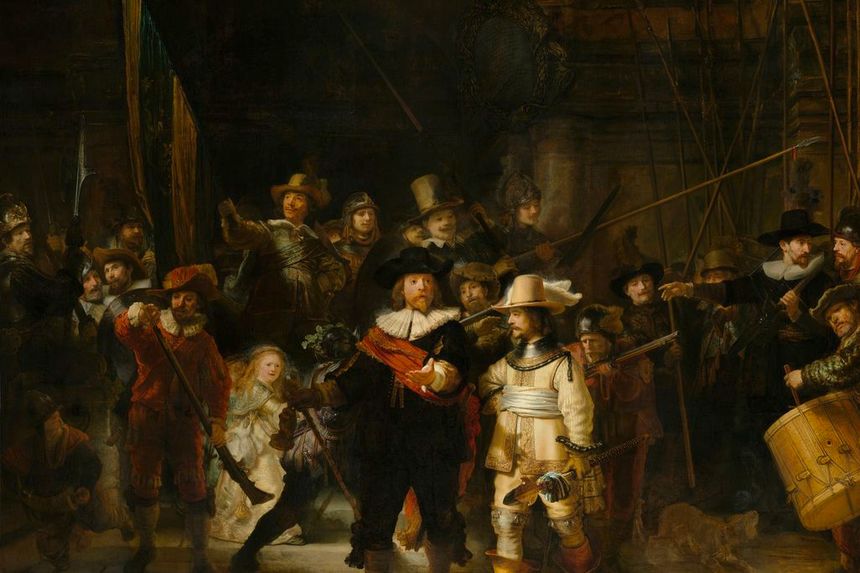
This work is not really about showing off a group of soldiers. It is more about thinking about what happens when a person steps forward and everyone else keeps moving. It is about the moment between being part of a group and being seen as one person.
In The Night Watch, painted by Rembrandt van Rijn in 1642, we see a militia company that is not standing still. They are walking, turning, loading a musket, looking up. Captain Frans Banninck Cocq is stepping forward, his hand on his sword, his black coat and red sash pulling your eye to him before anything else. The lieutenant beside him in yellow is looking down, writing or counting. No one is looking at you. That is the strange thing. You are not being posed for. You are watching them without them knowing.
The light is what does the most work here. The background is dark, almost black, and the figures come out of it like they are lit by a window you cannot see. Some faces are fully lit, others are half in shadow, and a few are almost gone. This is not a flat portrait where everyone gets the same light. Rembrandt is choosing who is present and who is fading.
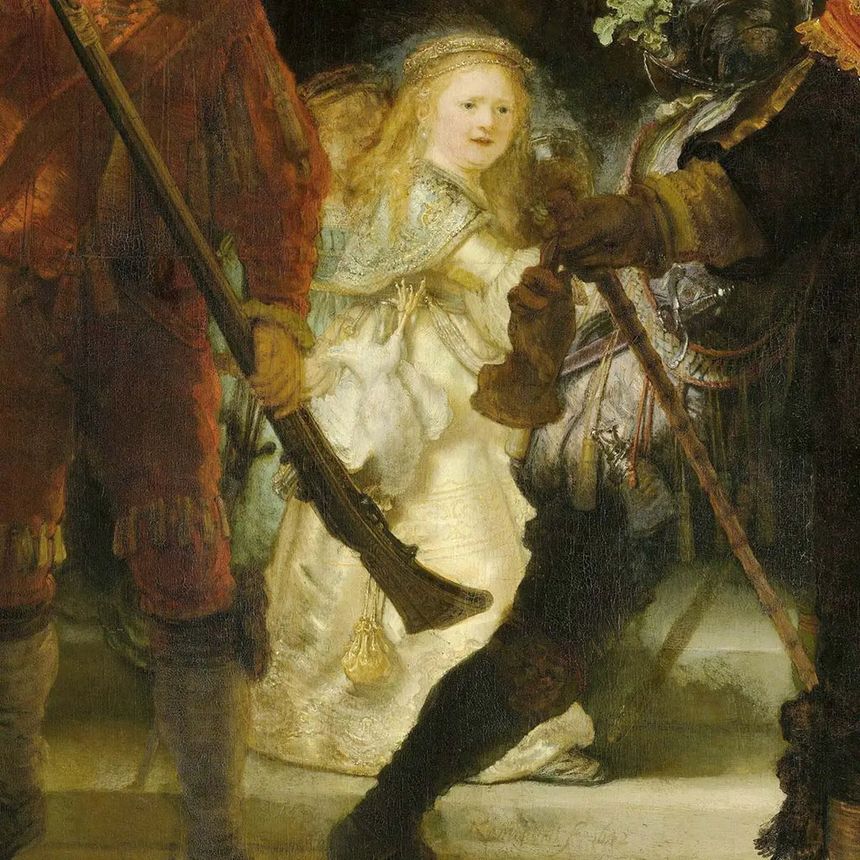
The girl in yellow in the far back, holding a chicken, is the smallest figure but she is the brightest. She is not doing anything important. She is just there. And because she is there, the whole scene feels like a real street, not a stage.
The way the figures overlap and the way some are cut off at the edge of the canvas is a matter of technique before it is a matter of meaning. The painting was trimmed on all four sides in 1715 to fit a new wall, and we are seeing a version that is smaller than what Rembrandt made. That means the edges are not his choice. They are an accident. But even with that, the composition works.
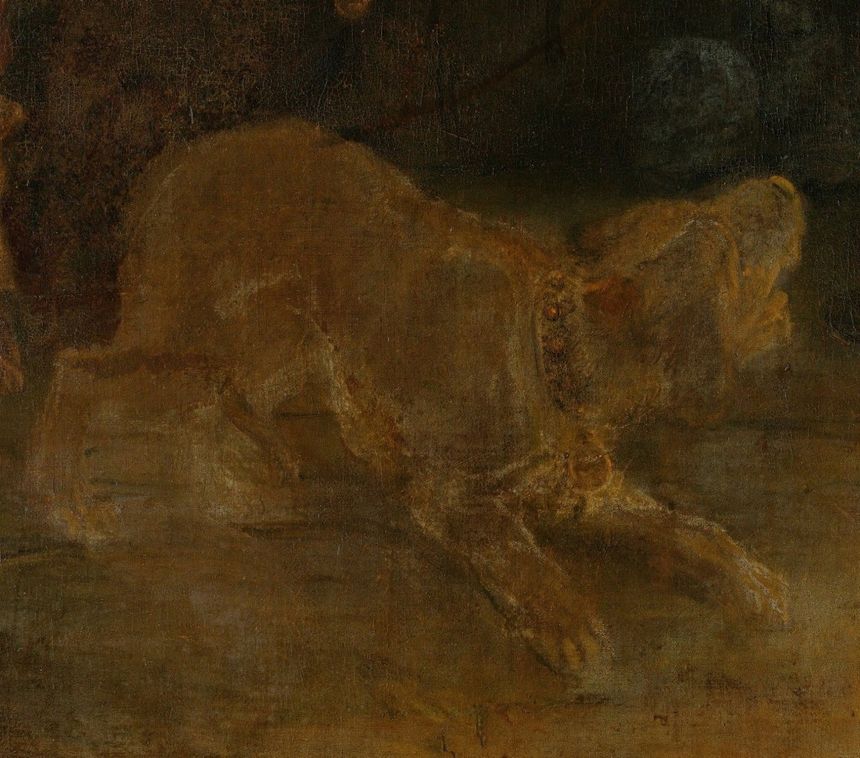
The line of the musket, the diagonal of the banner, the way the dog is running forward, all of it pushes the group toward the left, toward the viewer. We are not allowed to see the whole company. We have to stay at this angle, this distance. The painting does not open up. It stays in this one frozen second.
The name The Night Watch is chosen for a reason, even though it is wrong. The scene is not at night. The name came from the varnish darkening over two hundred years, and people just kept calling it that. But the name makes you think about something else. A watch is something you do when you are tired, when you are waiting, when you are not supposed to fall asleep. The militia is not fighting. They are on duty. They are the ones who stay awake so other people can sleep. That is what the painting is really about. Not a group portrait. A moment of being on duty. Of being the one who has to keep moving while everyone else rests.
The Night Watch is not simple to understand. It does not make the militia look heroic in a clean way. It does not try to explain who each person is or what they did after this moment. It wants people, those who like to look at old paintings, to take their time and think about what they are seeing. They have to stand in front of it at the Rijksmuseum and try to figure out why the girl in yellow is there, why the dog is running, why no one is looking at you. It is not easy to understand at first.