This work is not really about a kitchen. It is more about what is inside a person when they are doing something that requires their full attention. It is about the moment where the outside world falls away and all that is left is the task and the body doing the task.
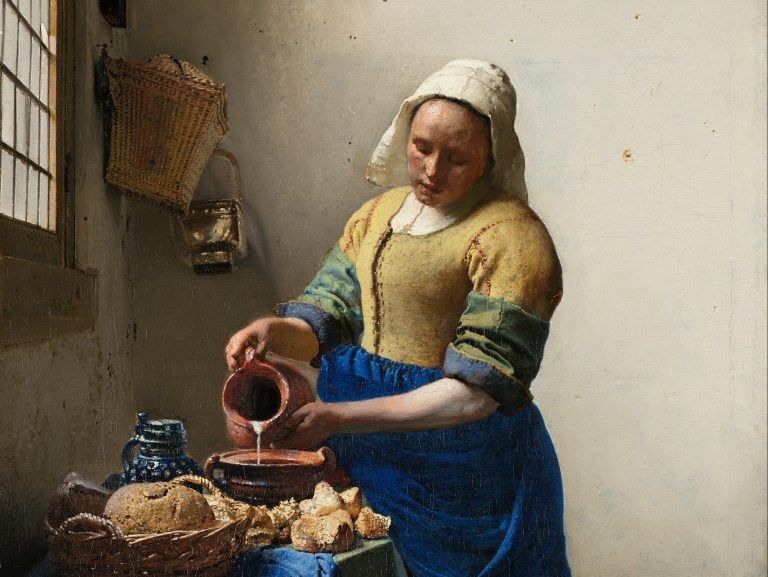
In The Milkmaid, which hangs in the Rijksmuseum in Amsterdam, Johannes Vermeer shows us a woman who is pouring milk from a jug into a bowl. She is not looking at you. Her face is half in shadow. You cannot tell if she is thinking about anything at all or if she is thinking about nothing. You do not know for sure. Her stillness feels real, she is not performing for anyone.
The skin of the figure is painted with thick dabs of paint, impasto, in small touches of white, light ocher, reddish-brown, and greenish-gray that coalesce into a solid head that seems to think and breathe. The yellow bodice is rough and coarse, painted with the same thick dabs, and it looks like the actual fabric. But the blue apron is smooth, almost like silk, made with a pigment called natural ultramarine, ground from lapis lazuli that was imported from Afghanistan. It is the most expensive blue pigment available at the time.
This difference in how the two fabrics are painted is important. It does not simply say that one cloth is rough and one is smooth. Vermeer’s painting shows a contrast between the body, which is built up from many small, separate touches that you have to let your eye assemble, and the apron, which is a single, deep, continuous field of color that holds everything together. The ultramarine is not something she is wearing. It is something that weighs on her the way the yellow weighs on her, but in a different way. Vermeer’s painting practice makes you think about the body and the clothes in a different way.
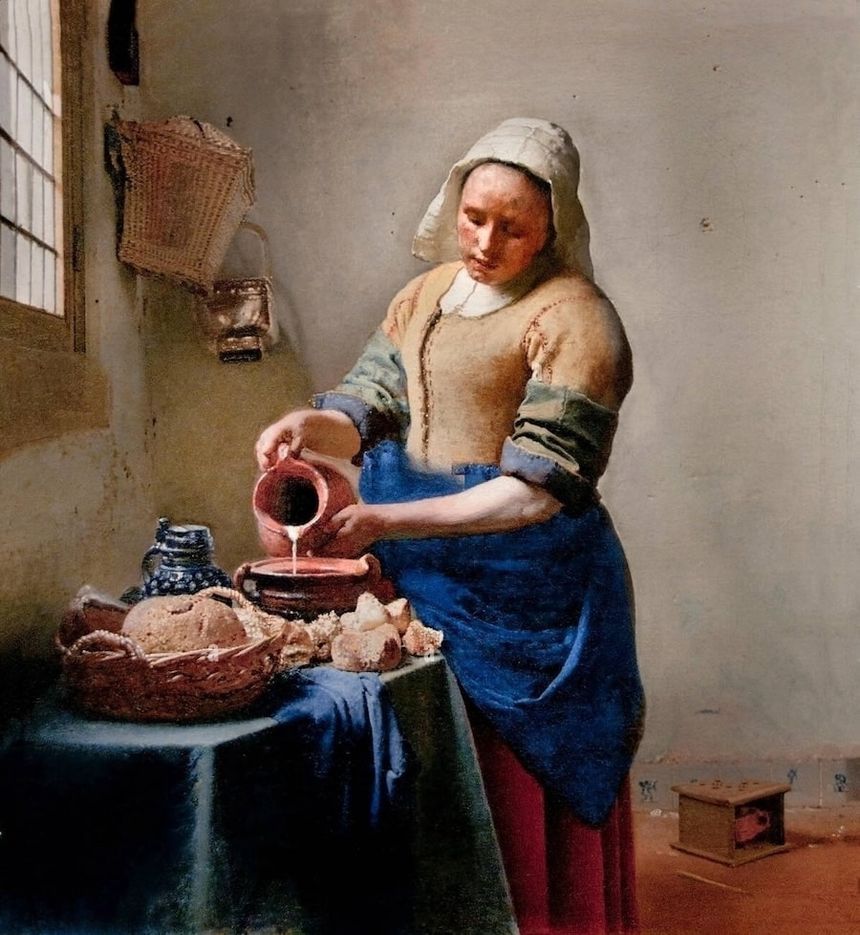
The bread on the table and the wicker basket are covered in tiny dots of pale paint, a technique called pointillé, and this is the most effusive use of that scheme in any Vermeer painting. The dots suggest light catching the rough texture of the crust at the same time. The wall behind her is painted with thick white lead in the bright areas and thin umber in the shadows, and it has a nail in it and small cracks and a hole. This is a matter of technique and style before it is a matter of meaning.
There is a line of demarcation, a thin stroke of white paint along the woman’s right side, that pushes the figure forward. The figure can still be seen without getting lost in the wall behind her. Vermeer knows that painting is different from just recording a scene. It is about making choices, what to include and what to leave out. He originally painted a basket hanging on the wall and a figure visible through the window, and he painted over both of them to simplify the composition.
The face is drawn in a way that is almost too real, the impasto dabs are so specific, and the person looking at the painting can connect with the figure. But we are not allowed to get close. We have to stay back a little. The low vantage point makes her look monumental, like a sculpture, but her face is turned down and away from us. The rough wall and the precise milk stream are still really noticeable. Vermeer is good at painting the figure in a way that is simple but still says a lot, about the person.
The name of the painting is The Milkmaid. This name is chosen for a reason. She is not really a milkmaid in the agricultural sense. She is a kitchen maid, a domestic servant. But the title gives her a kind of dignity that the word “kitchen maid” would not. Milkmaid carries history. It carries the history of women who worked with their hands, the history of labor, the history of being seen by men of higher social standing who collected paintings of them. The milk is the only thing that moves in the painting. Everything else is still. The stream of milk falling into the bowl is the pulse of the whole work. The painting is, about attention. How it makes us think about what it means to be fully absorbed in a task and what that does to the rest of the world.
Vermeer’s painting is not simple to understand. It does not make the domestic look flashy. It does not try to explain everything. Vermeer’s painting wants people, those who like to look at light and color and texture, to take their time and think about what they are seeing. They have to sit with The Milkmaid and try to figure out what is happening in that woman’s mind even if it is not easy to understand at first. You look at her and your first thought is, what is she thinking? And then you realize you do not know, and that not knowing is the point.